


AI-Powered Test Automation Guide
1. Why AI-Powered Test Automation Has Become a QA Essential
2. Core Features That Make AI-Driven Test Automation a Game Changer
3. Real-World Advantages of AI-Driven Test Automation
4. Real-World Example of AI-Powered Test Automation in Action
5. Autonomous Testing: The Future of QA
6. How to Implement AI-Powered Test Automation in Your QA Strategy
7. Conclusion: Transform Your QA Strategy With AI-Powered Test Automation
Why AI-Powered Test Automation Has Become a QA Essential
Legacy Automation Is No Longer Enough
- ◆Visual AI testing that understands screens like a human
- ◆Self-healing test automation that automatically resolves locator changes
- ◆Predictive analytics in QA to detect patterns in failures
- ◆Autonomous testing that generates test scenarios using machine learning
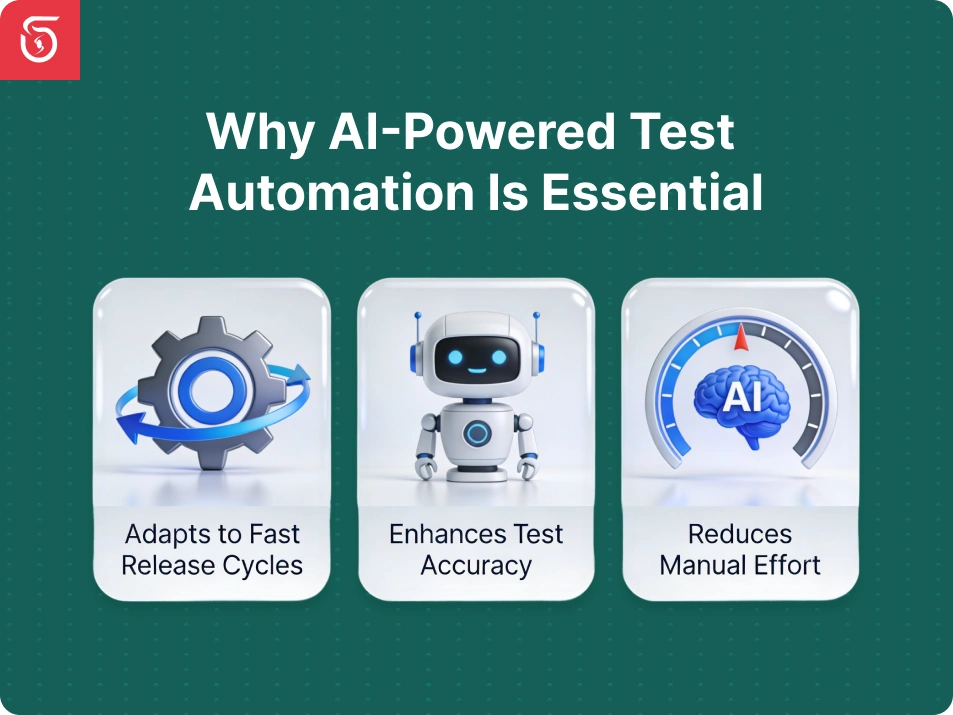
Core Features That Make AI-Driven Test Automation a Game Changer
1. Self-Healing Test Automation
- ◆Repair broken locators
- ◆Detect alternative paths
- ◆Re-learn object properties
- ◆Update test scripts dynamically
2. Visual AI Testing for Pixel-Perfect Accuracy
- ◆Layout shifts
- ◆Rendering issues
- ◆Dynamic components
- ◆Visual regressions
3. Codeless Automation for Faster Execution
- ◆Reduced dependency on developers
- ◆Faster onboarding
- ◆Accelerated creation of end-to-end scenarios
4. Machine Learning in QA for Predictive Intelligence
- ◆High-risk areas
- ◆Likely failure scenarios
- ◆Missing test cases
- ◆Bottlenecks in the pipeline
Real-World Advantages of AI-Driven Test Automation
Faster Release Cycles
Higher Test Coverage
Improved Accuracy and Defect Detection
Lower Cost of QA Operations
Real-World Example of AI-Powered Test Automation in Action
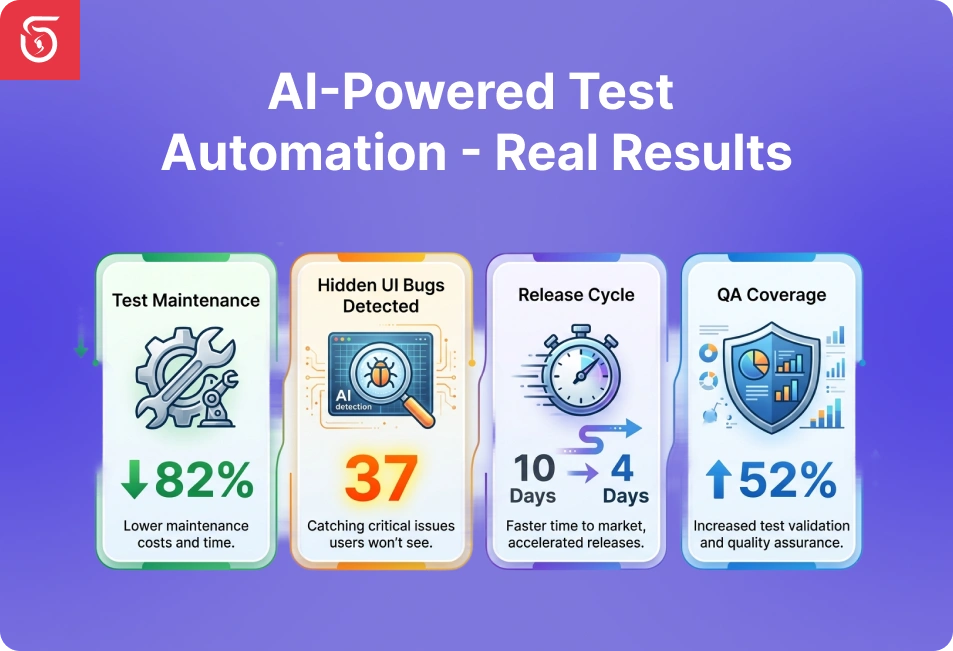
- ◆Test maintenance dropped by 82%
- ◆Visual AI identified 37 previously undetected UI bugs
- ◆Release cycle time decreased from 10 days to 4 days
- ◆QA coverage increased by 52%
Autonomous Testing: The Future of QA
- ◆Generates test cases
- ◆Executes them
- ◆Analyzes results
- ◆Learns continuously
Generative AI for Testing
- ◆Write test scripts
- ◆Create data sets
- ◆Build edge-case scenarios
- ◆Identify missing coverage
How to Implement AI-Powered Test Automation in Your QA Strategy
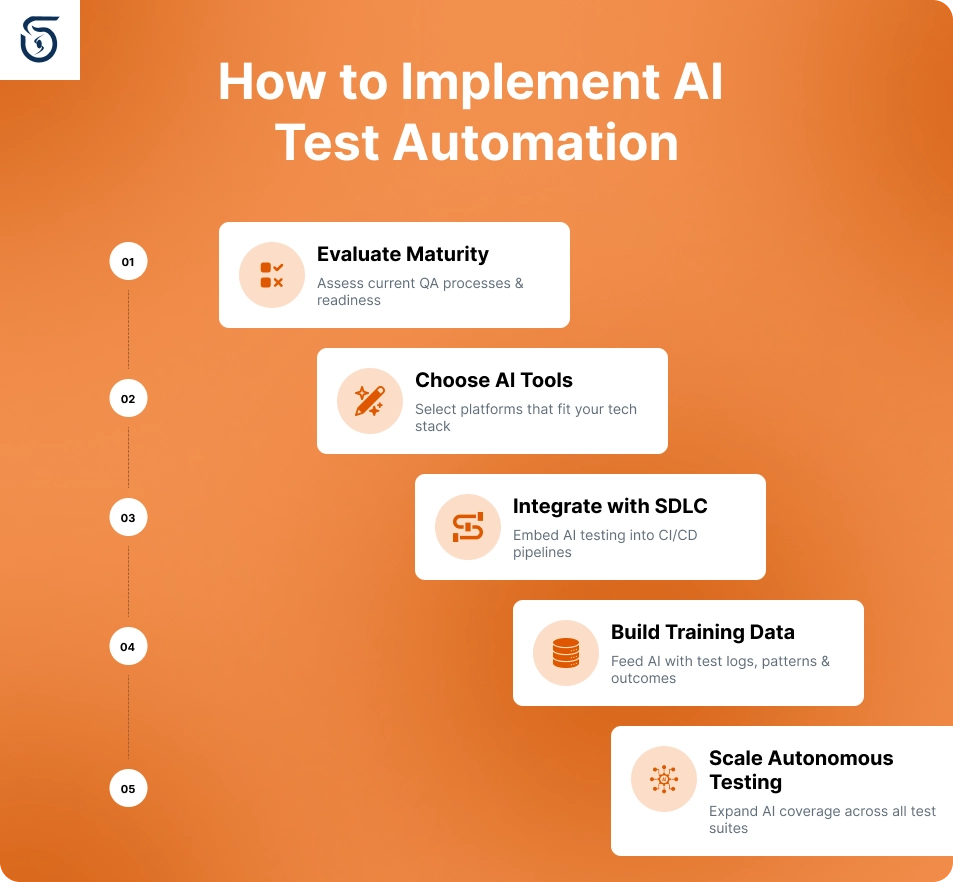
Step 1: Evaluate Your Current Test Maturity
Step 2: Choose the Right AI Test Automation Tools
- ◆Visual AI
- ◆Self-healing
- ◆Low-code automation
- ◆Machine learning insights
- ◆Seamless CI/CD integration
Step 3: Integrate AI Into the SDLC
Step 4: Build a Training Dataset
Step 5: Scale with Autonomous Testing

Never Miss an Update
Add SoftSages Technology as a Preferred Source on Google for more of our latest tech content in AI Mode and AI Overviews.
Conclusion: Transform Your QA Strategy With AI-Powered Test Automation
If you’re ready to transform your QA pipeline with AI, explore our advanced AI Services to modernize automation, improve coverage, and accelerate releases. Not sure which direction to take? and let our team guide you.
Table of contents
Why AI-Powered Test Automation Has Become a QA Essential
Core Features That Make AI-Driven Test Automation a Game Changer
Real-World Advantages of AI-Driven Test Automation
Real-World Example of AI-Powered Test Automation in Action
Autonomous Testing: The Future of QA
How to Implement AI-Powered Test Automation in Your QA Strategy
Conclusion: Transform Your QA Strategy With AI-Powered Test Automation
Join Our Newsletter
Get the latest tech trends, tutorials and expert analysis delivered straight to your inbox.
AI-Powered Test Automation FAQs
AI-powered test automation uses machine learning and intelligent algorithms to generate, execute, and maintain software tests automatically. It is essential because it reduces test maintenance, improves accuracy, expands coverage, and accelerates delivery in CI/CD environments where traditional testing cannot be kept up.
AI-driven automation is adaptive and self-learning, while traditional automation is static and script-dependent. AI can update locators, detect UI changes, analyze risk, and generate tests automatically making it far more resilient and scalable than scripted automation.
Self-healing test scripts automatically update broken element locators when the UI changes. AI detects alternative attributes, identifies patterns, and repairs tests without human effort reducing maintenance time by up to 70%.
No. AI enhances testing but does not eliminate the need for human expertise. Testers still handle strategy, risk analysis, exploratory testing, user experience validation, and decision-making areas AI cannot fully automate.
Leading tools include platforms with capabilities such as visual AI testing, self-healing automation, predictive analytics, low-code creation, and generative AI-based test generation. Enterprises typically choose tools that integrate well with CI/CD, support cross-browser testing, and use machine learning to optimize test suites.
AI analyzes historical test data, user behavior, defect patterns, and code changes to predict high-risk areas. This helps prioritize test cases, identify likely points of failure, and optimize coverage leading to earlier defect detection and more reliable releases.
Generative AI can write test cases, create boundary conditions, generate unit tests, convert requirements into test scripts, and improve test clarity. It automates documentation, reduces scripting time, and enhances coverage by suggesting missing scenarios.
Autonomous testing is a model where AI plans, generates, executes, maintains, and optimizes tests without human intervention. While early forms exist today, full autonomy is emerging and expected to mature in the next few years as AI improves reasoning and decision-making.
Yes. AI is well-suited for complex and legacy systems because it can analyze large test datasets, learn from past failures, and adapt to UI changes. It helps stabilize flaky tests and reduces maintenance even in large enterprise environments.
Common challenges include tool learning curves, data quality requirements, initial implementation costs, integration with existing frameworks, and the black box effect where AI decisions are not always transparent. Proper training and governance help overcome these barriers.