


Contract Staffing vs Permanent Hiring: Which Model Works Best?
1. What Is Contract Staffing?
2. What Is Permanent Hiring?
3. Contract Staffing vs Permanent Hiring: Key Differences
4. Which Model Is More Cost-Effective?
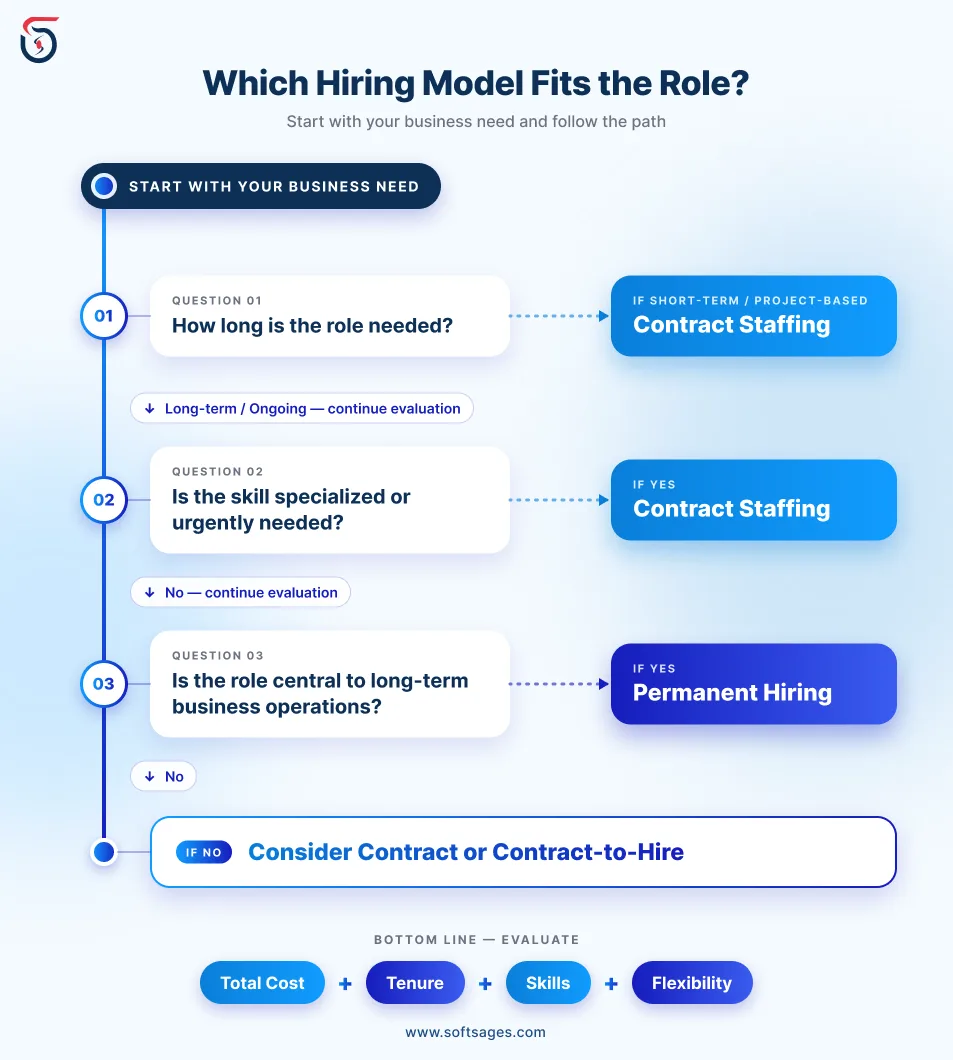
5. When Should You Choose Contract Staffing?
6. When Should You Choose Permanent Hiring?
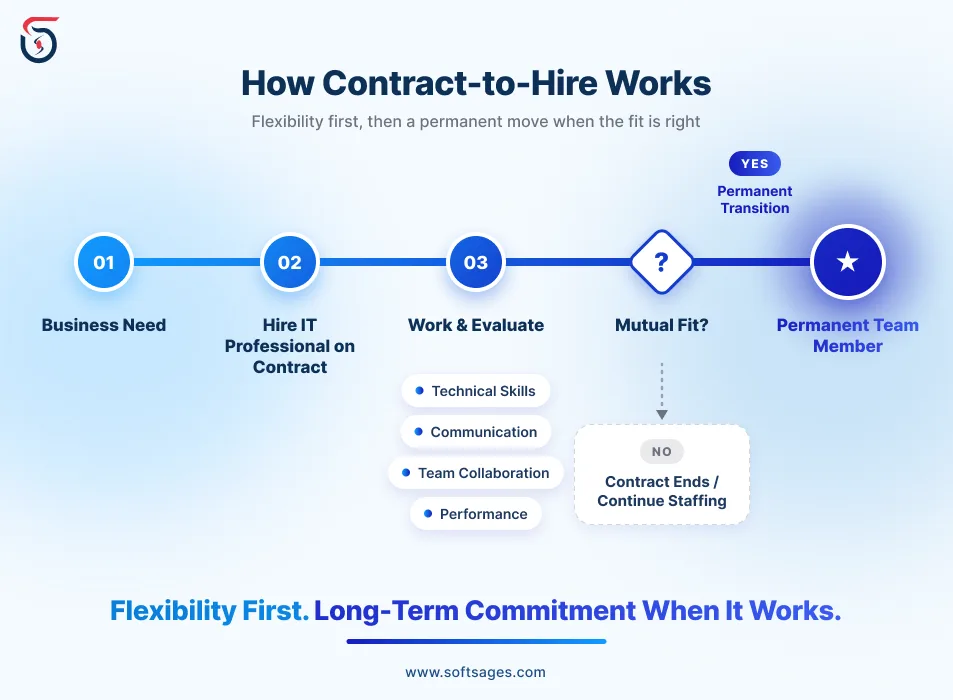
7. What About Contract-to-Hire?
8. So, Which Hiring Model Works Best?
9. Build the Right IT Team for Your Business
What Is Contract Staffing?
Benefits of Contract Staffing
- ◆Faster access to talent: Contract staffing can help businesses fill urgent technical positions more quickly than traditional permanent recruitment.
- ◆Greater flexibility: Companies can increase or reduce their workforce according to project requirements, workload, or changing business priorities.
- ◆Access to specialized skills: Organizations can bring in professionals with specific technical expertise without maintaining those skills as permanent positions.
- ◆Lower long-term commitment: When a project ends or business requirements change, the organization may have more flexibility than it would with a permanent employee.
- ◆Useful for project-based work: Contract professionals can support software development, cloud migration, application testing, digital transformation, and other time-bound initiatives.
What Is Permanent Hiring?
Benefits of Permanent Hiring
- ◆Long-term stability: Permanent employees can develop deeper knowledge of the company, its products, customers, and processes.
- ◆Stronger team integration: Employees who expect to remain with an organization for the long term may develop stronger relationships and collaboration with internal teams.
- ◆Institutional knowledge: Permanent employees can retain technical and business knowledge that may be difficult to replace.
- ◆Long-term career development: Companies can invest in training, leadership development, and career progression for employees who are expected to stay for the long term.
- ◆Better fit for core positions: Permanent hiring can make sense when a role is central to the company's long-term strategy.
Contract Staffing vs Permanent Hiring: Key Differences
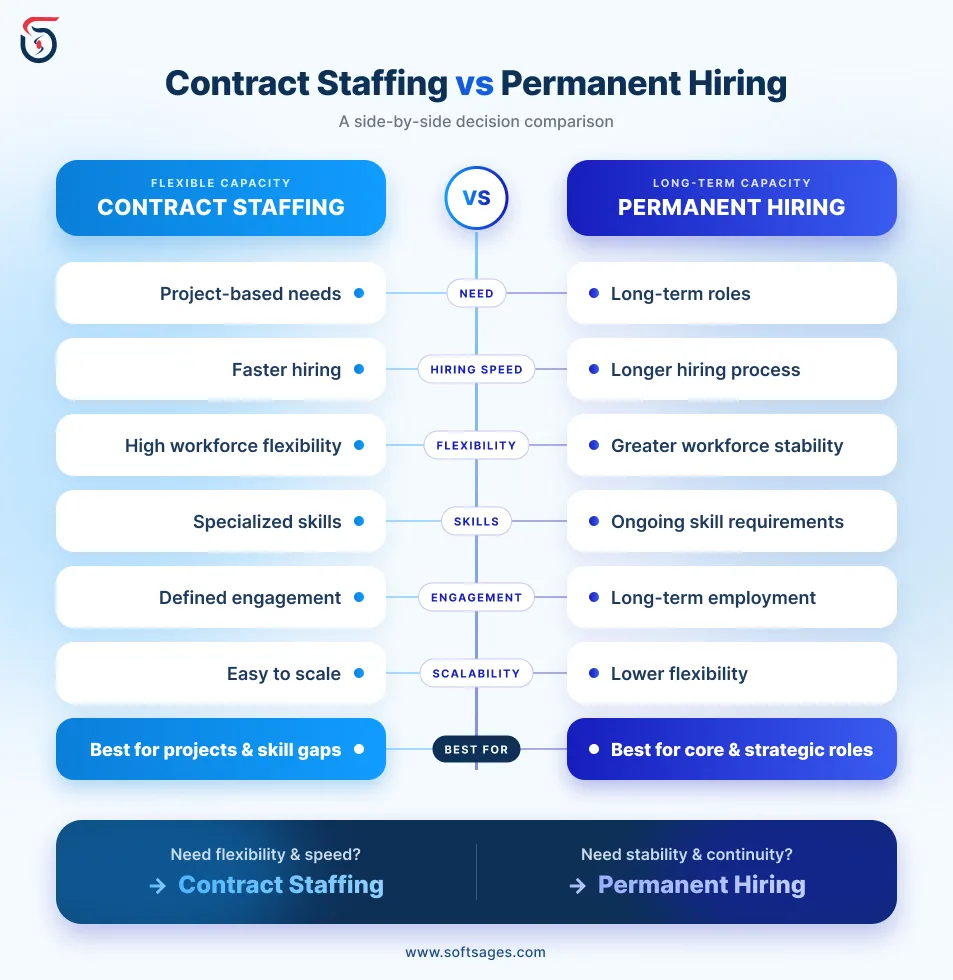
| Factor | Contract Staffing | Permanent Hiring |
|---|---|---|
| Hiring purpose | Short-term, project, or flexible needs | Long-term workforce requirements |
| Workforce flexibility | High | Moderate to low |
| Hiring speed | Generally faster | Can take longer |
| Commitment | Defined contract period | Long-term employment |
| Specialized skills | Excellent for temporary skill gaps | Suitable for ongoing skill requirements |
| Team integration | Can be strong during assignment | Usually deeper over time |
| Best for | Projects, workload spikes, skill gaps | Core teams and strategic roles |
| Scalability | Easy to increase or decrease | Less flexible |
Which Model Is More Cost-Effective?
When Should You Choose Contract Staffing?
- ◆You need technical talent quickly.
- ◆Each project follows a predetermined timeline from initiation through completion.
- ◆Your workload is temporarily increasing.
- ◆You need specialized skills for a specific initiative.
- ◆You are entering a new technology area and need expertise without creating permanent headcount.
- ◆You want flexibility to scale your team.
- ◆You need temporary coverage for an existing position.
When Should You Choose Permanent Hiring?
- ◆The position is required indefinitely.
- ◆The role is central to your business.
- ◆The employee needs deep knowledge of internal systems.
- ◆You want to build a stable technical team.
- ◆Long-term collaboration and retention are priorities.
- ◆You plan to invest significantly in employee development.
- ◆The role involves strategic decision-making or leadership.
What About Contract-to-Hire?
So, Which Hiring Model Works Best?

Never Miss an Update
Add SoftSages Technology as a Preferred Source on Google for more of our latest tech content in AI Mode and AI Overviews.
Build the Right IT Team for Your Business
Not sure which hiring model fits your next role? SoftSages Technology can review your project timeline, required skills, and budget and help you choose between contract, contract-to-hire, and direct hire.
Table of contents
What Is Contract Staffing?
What Is Permanent Hiring?
Contract Staffing vs Permanent Hiring: Key Differences
Which Model Is More Cost-Effective?
When Should You Choose Contract Staffing?
When Should You Choose Permanent Hiring?
What About Contract-to-Hire?
So, Which Hiring Model Works Best?
Build the Right IT Team for Your Business
Join Our Newsletter
Get the latest tech trends, tutorials and expert analysis delivered straight to your inbox.
FAQ: Contract Staffing vs. Permanent Hiring
Contract staffing hires IT professionals for a defined period, project, or business requirement, while permanent hiring brings employees into the organization for an ongoing role.
Key differences include:
- Contract staffing: Greater workforce flexibility and shorter-term commitment
- Permanent hiring: Greater stability and long-term organizational continuity
- Contract staffing: Suitable for projects, temporary workload increases, and specialized skills
- Permanent hiring: Better suited to core roles and long-term business needs
Neither model is universally better. The right choice depends on the organization's workforce requirements.
- Choose contract staffing for short-term projects, urgent hiring, specialized skills, or fluctuating workloads.
- Choose permanent hiring for core business roles that require long-term commitment, team integration, and institutional knowledge.
A company should consider contract staffing when:
- IT professionals are needed quickly
- Specialized technical skills are required for a specific project
- Workload is temporarily increasing
- A project has a defined timeline
- The company wants to scale its workforce without adding permanent headcount
- Temporary coverage is needed for an existing position
Permanent hiring is generally a better option when:
- The position is expected to remain necessary long term
- The role is central to business operations
- Employees need deep knowledge of internal systems and processes
- Long-term collaboration and retention are priorities
- The company wants to invest in employee development
- The role involves strategic decision-making or leadership
It depends on the role, engagement period, and total employment costs.
Contract staffing may be more practical for short-term or project-based requirements because businesses can access talent for a defined period. Permanent hiring may provide better long-term value for positions that are continuously required.
Businesses should compare:
- Total employment costs
- Engagement duration
- Productivity
- Recruitment and onboarding costs
- Benefits and administrative expenses
- Workforce flexibility
Avoid comparing only contractor rates with employee salaries.
Contract staffing is generally faster. Staffing providers can help businesses access qualified professionals for immediate or short-term requirements.
Permanent hiring can take longer because it typically involves:
- Candidate sourcing
- Screening
- Interviews
- Technical evaluation
- Selection
- Onboarding
For urgent IT projects, contract staffing can therefore provide faster access to specialized talent.
Yes. A contract-to-hire arrangement allows an IT professional to initially work on a contract basis and potentially transition into a permanent position.
This gives both the company and the professional an opportunity to evaluate:
- Technical skills
- Work performance
- Communication
- Team collaboration
- Cultural and organizational fit
If both sides agree, the professional can transition to permanent employment.
Yes. Contract staffing is particularly suitable for IT projects that require specialized skills for a defined period.
Common examples include:
- Software development
- Cloud migration
- DevOps
- Cybersecurity
- Data engineering
- Quality assurance
- Digital transformation
- Application modernization
This model allows organizations to add technical expertise without necessarily creating permanent positions.
Permanent IT employees can provide several long-term advantages:
- Workforce stability: Consistent team capacity over time
- Team integration: Stronger collaboration with internal teams
- Institutional knowledge: Deeper understanding of systems, products, and processes
- Continuity: Better knowledge retention across projects
- Career development: Opportunities for training and leadership development
- Strategic contribution: Greater alignment with long-term technology goals
Permanent hiring is particularly useful for core technical and strategic roles.
Yes. Many organizations use a hybrid workforce model.
For example:
- Permanent employees can form the core technical team.
- Contract professionals can provide additional capacity during project peaks.
- Specialized contractors can support initiatives requiring skills that are not needed continuously.
This approach combines workforce stability with flexibility and allows businesses to adjust their technical capacity as requirements change.
Consider these five key factors:
- Role duration: How long will the position be needed?
- Skill requirements: Is the required expertise specialized or ongoing?
- Hiring urgency: How quickly does the business need the professional?
- Workforce budget: What are the total costs of each hiring model?
- Strategic importance: Is the position part of the organization's long-term strategy?
Short-term, urgent, and flexible requirements generally favor contract staffing, while ongoing strategic roles generally favor permanent hiring.
Businesses can choose from several IT staffing models, depending on their project requirements and workforce strategy:
- Staff augmentation: Add skilled professionals to an existing team
- Project staffing: Build a team for a specific project
- Temporary staffing: Fill short-term workforce requirements
- Contract-to-hire: Evaluate professionals before making a permanent commitment
- Offshore recruiting: Access technical talent from global locations
- Direct hire: Recruit professionals for permanent positions
The right model depends on the project scope, hiring timeline, technical skills required, budget, and long-term workforce strategy.