
SoftSages company logo
LinkedIn professional network iconFacebook social media icon

Conversational AI with Language Models: From Architecture to Enterprise
May 08, 2026 15 mins read SoftSages Team AI and ML Development
Conversational AI with language models

1. What Is a LLM and How Does It Power Conversational AI?


2. Core Architecture of a Conversational AI System


3. Top Companies Offering Conversational AI Solutions Powered by LLMs


4. How to Integrate Conversational AI with Popular Language Model APIs


5. How Advanced Language Models Enhance User Experience in Chatbots


6. Pricing Comparison for Conversational AI Services


7. Which Conversational AI Products Support Multiple Languages?


8. Comparing Conversational AI Platforms for Enterprise Use

We are living through a quiet but profound revolution. Every time you ask a virtual assistant for help, resolve a customer's complaint through an automated chat, or get a code snippet from an AI tool, a large language model (LLM) is doing the heavy lifting behind the scenes. Conversational AI has moved from scripted, rule-bound bots to fluid, context-aware systems that can hold nuanced multi-turn dialogues - and Businesses adopting AI are increasingly leveraging AI and ML development services to build scalable conversational systems.
This blog unpacks the full picture: what LLMs are, how they work inside a conversational AI system, which companies are leading the race, how enterprises can integrate these models into their workflows, and what the landscape looks like when you start comparing platforms, pricing, and multilingual support.

What Is a LLM and How Does It Power Conversational AI?

A large language model is a deep learning system trained on massive corpora of text data - books, articles, code repositories, websites, and more - using a transformer architecture. The transformer's self-attention mechanism allows the model to understand relationships between words across long sequences, rather than reading text purely left-to-right. This is what gives LLMs their remarkable ability to understand context, infer intent, and generate coherent, relevant responses.
When an LLM is integrated into a conversational AI system, it acts as the reasoning core. It interprets the user's input, maintains conversational context across multiple turns, and generates a response that is statistically probable and semantically appropriate. Unlike traditional chatbots that rely on keyword matching or decision trees, LLM-powered chatbots can handle ambiguous phrasing, follow-up questions, and topic shifts with surprising fluency.
The key innovation is the concept of in-context learning - the ability of the model to adapt its behavior based on instructions or examples provided at inference time (the system prompt), without any retraining. This is what makes LLMs extraordinarily flexible as the backbone of conversational AI products.

Core Architecture of a Conversational AI System

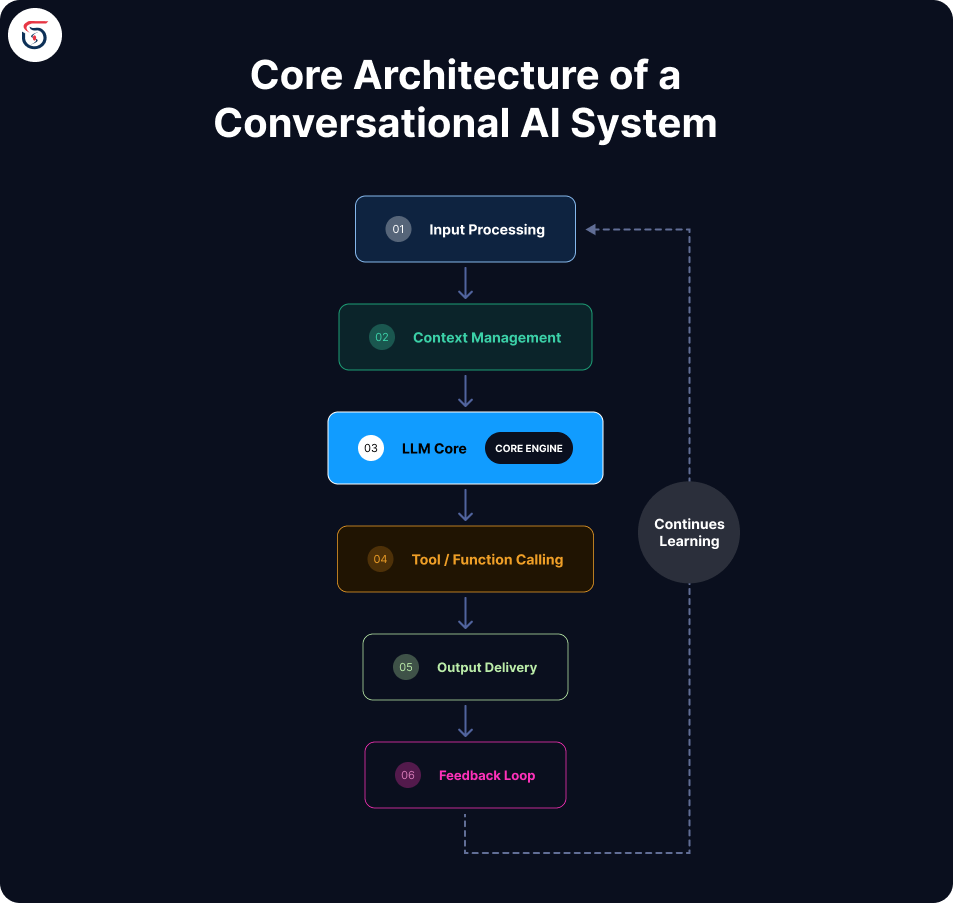
Understanding how conversational AI is structured helps teams build and integrate it more effectively. A modern LLM-powered conversational system typically consists of the following layers:
1. Input Processing Layer User input - whether text, voice, or structured data - is received and preprocessed. For voice interfaces, speech-to-text (STT) transcription happens here. The input is then tokenized and formatted for the model.
2. Context Management This layer maintains the conversation history - the series of user and assistant turns - which is passed to the model on each request. Long-context models (like GPT-4o with 128K tokens or Gemini 1.5 Pro with 1M tokens) can retain very long conversations. For applications requiring persistent memory across sessions, vector databases (like Pinecone or Weaviate) are often used to store and retrieve relevant conversation snippets.
3. The LLM Core The model receives the system prompt (instructions defining the AI's persona, rules, and goals), the conversation history, and the latest user message. It processes this and generates a response token by token using probabilistic sampling.
4. Tool / Function Calling Layer Modern LLMs support function calling - they can decide to invoke external APIs, query databases, run code, or search the web rather than generating a purely text-based answer. This layer handles those integrations and feeds results back to the model for synthesis.
5. Output Delivery The model's response is post-processed (safety filters, formatting, text-to-speech if needed) and delivered to the user interface. Streaming responses - where tokens are shown as they are generated - are now standard for a responsive user experience.
6. Feedback and Evaluation Loop Production systems include logging, monitoring, and evaluation pipelines to track response quality, latency, and user satisfaction. This data feeds continuous improvement cycles.
Conversational AI architecture

Top Companies Offering Conversational AI Solutions Powered by LLMs

The competitive landscape has never been more crowded - or more exciting. Here are the key players:

Anthropic (Claude)

Claude models - including Claude Sonnet and Claude Opus - are widely praised for their nuanced reasoning, long-context handling (up to 200K tokens), and strong safety alignment. Claude excels in enterprise document analysis, coding assistance, and complex multi-step reasoning tasks.

OpenAI (ChatGPT / GPT-4o)

OpenAI remains the category-defining name. GPT-4o is a multimodal model capable of processing text, images, and audio. The ChatGPT product has the broadest consumer reach, while the API powers thousands of third-party applications.

Google DeepMind (Gemini)

Gemini 1.5 Pro boasts the longest context window commercially available (1 million tokens), making it exceptional for document-heavy enterprise use cases. Google's tight integration with Workspace products gives it a strong enterprise distribution advantage.

Meta (Llama)

Meta's Llama 3 family is the flagship open-source LLM, freely available for commercial use. It powers a growing ecosystem of self-hosted and fine-tuned conversational applications, especially popular among teams with data privacy constraints.

Mistral AI

A French AI startup offering compact, highly capable open-weight models. Mistral's models are known for strong multilingual performance and efficiency, making them attractive for European enterprises navigating GDPR requirements.

Cohere

Focused squarely on the enterprise, Cohere offers models optimized for retrieval-augmented generation (RAG), classification, and semantic search - core capabilities for business-facing conversational AI.
Integrating an LLM API into a product is more accessible than ever. Here is a practical overview:
Choosing an API Provider Start by assessing your requirements: latency sensitivity, context window needs, budget, data residency rules, and whether you need multimodal capabilities. OpenAI, Anthropic, Google, and Cohere all offer REST APIs with SDKs for Python, JavaScript, and other languages.
Core Integration Pattern The fundamental pattern involves constructing a messages array (system prompt + conversation history + new user message), calling the /v1/messages or /v1/chat/completions endpoint, and parsing the response. Most APIs now support streaming via server-sent events.
Using Open-Source Frameworks For teams building more complex applications, frameworks like LangChain and LlamaIndex provide abstractions for chaining LLM calls, managing memory, integrating vector databases, and orchestrating tool use. Both have extensive documentation and active communities.
LangChain (docs at python.langchain.com) is the most widely used orchestration framework, supporting dozens of model providers and offering pre-built chains for conversational retrieval, agents, and structured output parsing.
LlamaIndex specializes in indexing and retrieving from large document collections, making it the go-to choice when your conversational AI needs to reason over a private knowledge base.

How Advanced Language Models Enhance User Experience in Chatbots

The jump from rule-based bots to LLM-powered assistants is not incremental - it is categorical. Here is how advanced models improve the end-user experience:
Natural, Contextual Dialogue: LLMs understand that "fix it" refers to the code snippet shared three messages ago, without needing the user to repeat themselves. This multi-turn coherence dramatically reduces user frustration.
Tone and Persona Consistency: Through the system prompt, developers can define a consistent personality - formal, friendly, concise, empathetic - that the model maintains reliably across thousands of conversations.
Handling Edge Cases Gracefully: Traditional bots break or give nonsensical responses when users phrase requests unexpectedly. LLMs handle paraphrasing, typos, colloquialisms, and ambiguous phrasing with far greater resilience.
Proactive Clarification: When a request is genuinely ambiguous, a well-prompted LLM will ask a targeted clarifying question rather than guessing wrong or returning an error.
Personalization at Scale: Combined with user profile data and conversation history retrieval, LLMs can deliver genuinely personalized responses without custom code for every scenario.

Pricing Comparison for Conversational AI Services

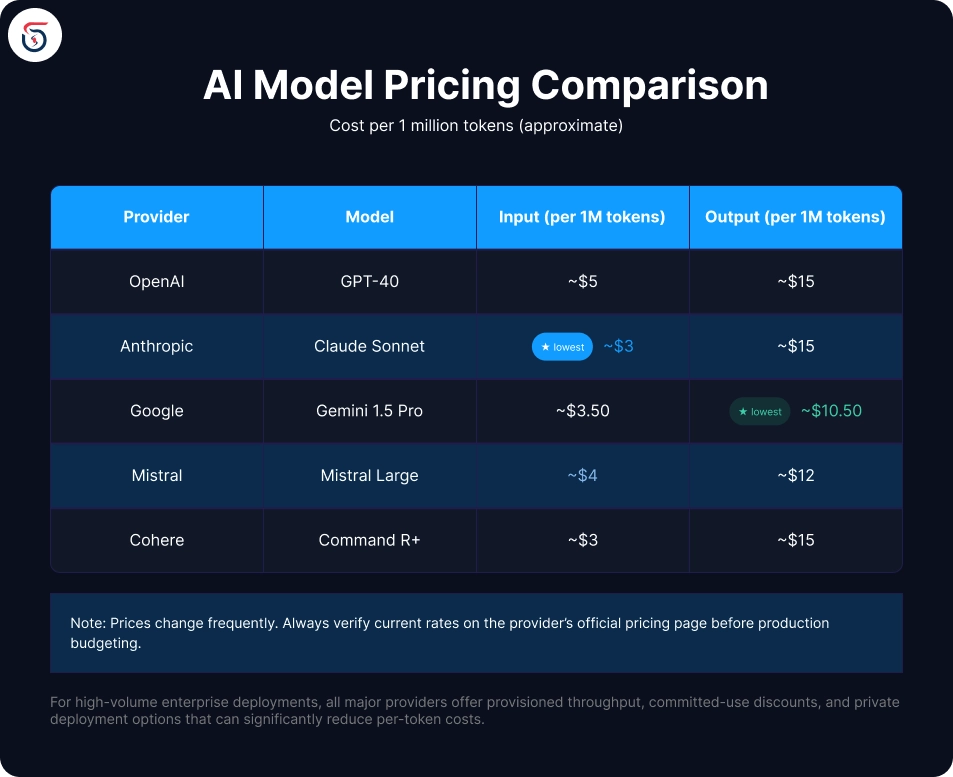
Pricing in this space is primarily usage-based, charged per million tokens (input + output). As of mid-2025, approximate benchmark prices for leading models are:
AI pricing comparison

Which Conversational AI Products Support Multiple Languages?

Multilingual capability is a must-have for global products. Here is the state of play:

GPT-4o and Claude 3

both demonstrate strong performance across over 50 languages, with particularly strong results in European languages, Chinese, Japanese, Arabic, and Hindi. Claude has been noted for careful handling of right-to-left scripts.

Gemini 1.5 Pro

is designed with multilingual use as a first-class priority, reflecting Google's global translation expertise. It supports over 100 languages.

Mistral models

have notably strong French, German, Spanish, and Italian performance - a deliberate design choice given the company's European roots and customer base.

Llama 3

includes dedicated multilingual variants (e.g., Llama 3.1) fine-tuned to improve non-English performance for open-source deployments.
For truly global deployments, it is worth testing your specific language pairs and domain vocabulary with each model rather than relying on general benchmarks.

Comparing Conversational AI Platforms for Enterprise Use

When selecting a platform for enterprise deployment, technical capability is only one dimension. Here is a multi-factor comparison framework:
Security and Compliance: Does the provider offer data processing agreements (DPAs), SOC 2 Type II certification, HIPAA-eligible configurations, and guaranteed data isolation? Anthropic, OpenAI, and Google all offer enterprise tiers with these assurances.
Deployment Flexibility: Some teams require on-premises or VPC deployment to meet data residency requirements. Open-source models (Llama, Mistral) offer maximum flexibility here. Among closed providers, Azure OpenAI Service and Google Cloud Vertex AI allow private deployment within your own cloud environment.
Customization: Does the platform support fine-tuning on proprietary data? OpenAI and Cohere offer fine-tuning APIs. Alternatively, RAG-based approaches (feeding relevant documents into the context at runtime) often deliver comparable results without the cost and complexity of fine-tuning.
SLA and Support: Enterprise deployments need guaranteed uptime, priority support queues, and dedicated account management. All major providers offer enterprise SLA tiers.
Integration Ecosystem: Platforms with pre-built connectors to Salesforce, ServiceNow, Microsoft 365, Slack, and Zendesk dramatically reduce integration timelines for enterprise buyers.

Want to build a powerful conversational AI solution for your business? Contact the SoftSages team to explore how we can help you design, develop, and scale AI-driven applications.

Table of contents

What Is a LLM and How Does It Power Conversational AI?


Core Architecture of a Conversational AI System

Top Companies Offering Conversational AI Solutions Powered by LLMs


How to Integrate Conversational AI with Popular Language Model APIs


How Advanced Language Models Enhance User Experience in Chatbots


Pricing Comparison for Conversational AI Services

Which Conversational AI Products Support Multiple Languages?


Comparing Conversational AI Platforms for Enterprise Use

Join Our Newsletter

Get the latest tech trends, tutorials and expert analysis delivered straight to your inbox.

FAQs about Conversational AI with Large Language Models

A traditional chatbot follows pre-written scripts and decision trees - it can only respond to inputs it was explicitly programmed to handle. An LLM-powered conversational AI understands natural language, maintains context across multiple turns, handles unexpected phrasing, and generates responses dynamically. The difference is roughly comparable to a vending machine versus a knowledgeable human assistant.

In most cases, no. Prompt engineering and retrieval-augmented generation (RAG) - where relevant documents are injected into the model's context at runtime - deliver strong results for the majority of use cases without the cost and complexity of fine-tuning. Fine-tuning is most valuable when you need the model to adopt a very specific style, domain vocabulary, or structured output format consistently at scale.

Costs depend on usage volume, the model tier selected, and average conversation length. For a low-traffic prototype, monthly API costs can be under \$50. For a high-traffic production application handling millions of conversations, costs can run into thousands of dollars per month. Most providers offer tiered pricing and volume discounts - always prototype with a smaller model first to validate before scaling.

OpenAI's API is widely recommended for beginners due to its extensive documentation, large community, broad framework support (LangChain, LlamaIndex, etc.), and the availability of the Playground for testing prompts without writing code. Anthropic's Claude API is also beginner-friendly with clear documentation and generous context windows.

Yes. Open-source models like Meta's Llama 3 and Mistral can be self-hosted on your own infrastructure, giving you full data sovereignty. Among closed providers, Azure OpenAI Service and Google Cloud Vertex AI allow deployment within your own cloud environment under your data governance policies - a common choice for healthcare, finance, and government sectors.

Most leading LLMs are trained on multilingual datasets and can understand and respond in dozens of languages without any configuration. For production multilingual deployments, it is best practice to test your specific target languages with real domain-specific queries, as performance can vary significantly by language and subject matter even within the same model.

RAG is a technique where the conversational AI retrieves relevant information from an external knowledge base (a vector database, document store, or search index) and includes it in the model's context before generating a response. This allows the AI to answer questions about your proprietary data - internal documentation, product catalogs, customer records - without retraining the model. RAG is currently the most popular architectural pattern for enterprise conversational AI.

Evaluation should cover multiple dimensions: response accuracy (are answers factually correct?), relevance (does the response address the actual question?), tone consistency, latency, safety (does it avoid harmful outputs?), and task completion rate. A combination of automated evaluation (using an LLM-as-judge approach) and human review panels is considered best practice for production systems.