Custom Software vs Off-the-Shelf Software: Which Is Right for Your Business?
October 6, 2026 • 8 mins read • SoftSages Team • Software Development
1. What Is Off-the-Shelf Software vs Custom Software?
2. Custom Software vs Off-the-Shelf Software: Side-by-Side Comparison
3. What Does Each Option Really Cost?
4. Speed, Flexibility, and Business Fit
5. Security, Compliance, and Risk
6. When Should You Choose Off-the-Shelf Software?
7. When Should You Build Custom Software?
8. The Hybrid Software Approach: Buy the Commodity, Build the Differentiator
9. Custom Software vs Off-the-Shelf Software: Quick Decision Checklist
10. Build, Buy, or Combine? Start With the Business Case
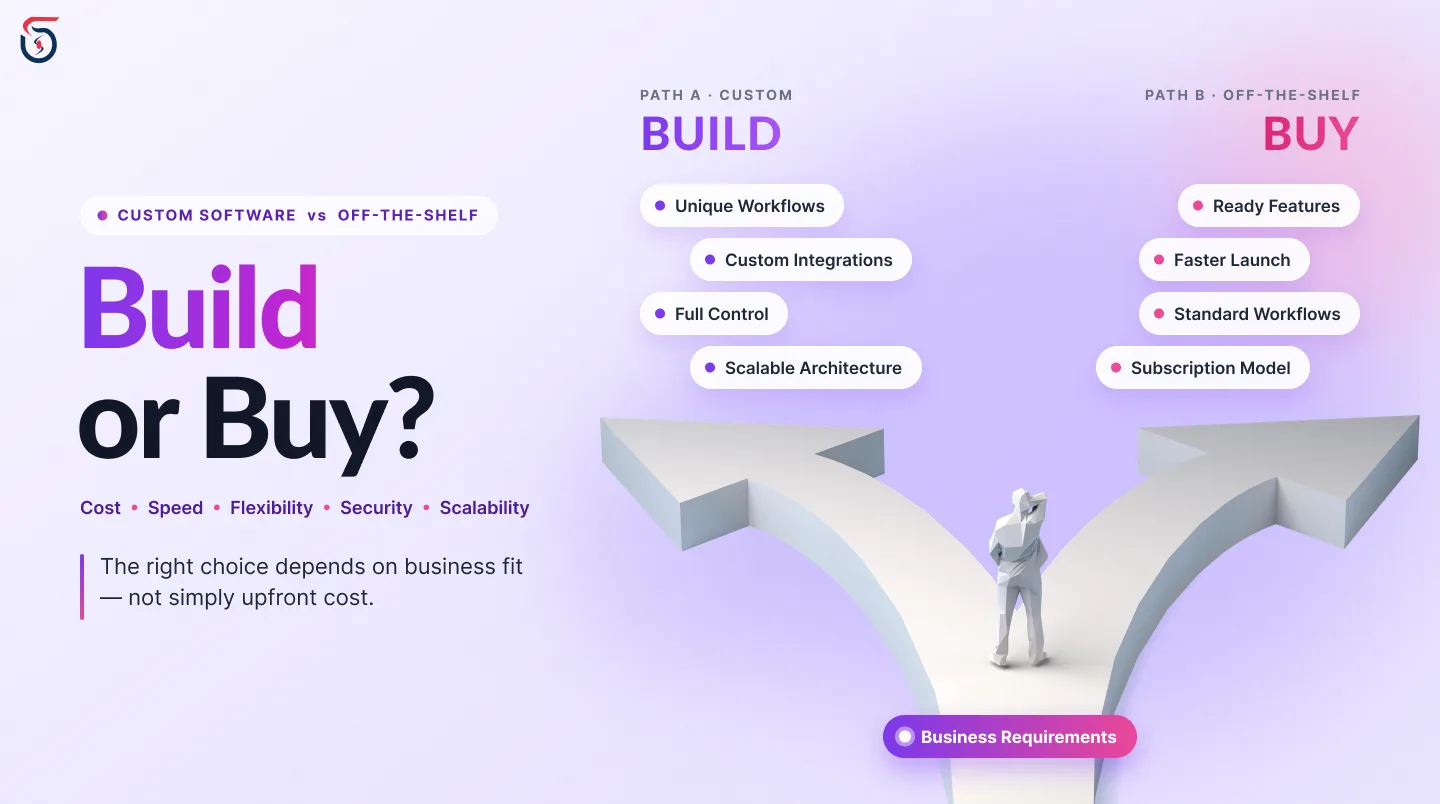
Choosing between custom software vs off-the-shelf software depends on more than the initial price. Off-the-shelf software can provide faster deployment, established features, and predictable subscription models, while custom software can provide greater control over workflows, integrations, scalability, and product direction. For some organizations, a hybrid software approach makes more sense: buy standard capabilities and build the systems that differentiate the business. The right decision depends on your requirements, budget, timeline, security needs, and expected five-year total cost of ownership.
Disclosure: SoftSages Technology develops custom software and also offers ready-made technology products, so this guide considers both build and buy approaches.
What Is Off-the-Shelf Software vs Custom Software?
Off-the-shelf software is a commercially available product designed to serve many organizations with similar requirements. It can include COTS (commercial off-the-shelf) or packaged software, as well as SaaS applications delivered through subscriptions. Examples include accounting, collaboration, CRM, project management, and HR platforms.
Custom software is developed around the requirements of a specific organization or business process. It may be built from scratch or developed by extending an existing platform. Custom applications are often considered when standard products cannot support specialized workflows, integrations, security requirements, or scalability needs.
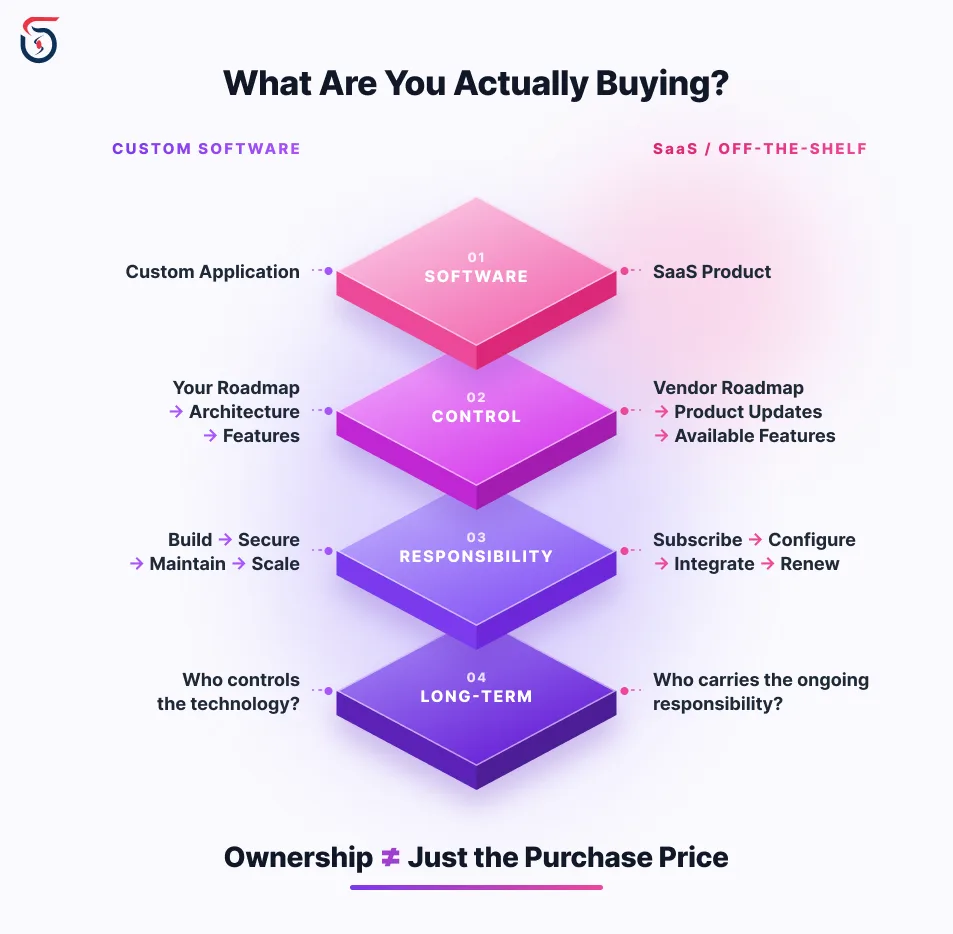
The difference between custom software vs SaaS is therefore primarily about control and fit versus standardized functionality and speed. Neither model is automatically better for every business.
Custom Software vs Off-the-Shelf Software: Side-by-Side Comparison
Factor
Custom Software
Off-the-Shelf Software
Upfront cost
Usually higher
Usually lower
Time to launch
Usually longer
Usually faster
Business fit
Built around your processes
Designed for a broad market
Customization
High
Limited to available features
Integrations
Designed around required systems
Depends on APIs and connectors
Ongoing cost
Maintenance, hosting, support
Subscription, upgrades, add-ons
Ownership/control
Greater control, depending on contract
Vendor controls product roadmap
Main risk
Scope, delivery, maintenance
Lock-in, limitations, price changes
The pros and cons of custom software vs off-the-shelf software become clearer when you compare total ownership costs and business requirements rather than only the purchase price.
Need help evaluating the build-versus-buy decision? Explore custom software development services from SoftSages Technology to assess your workflows, integrations, architecture, and long-term requirements.
What Does Each Option Really Cost?
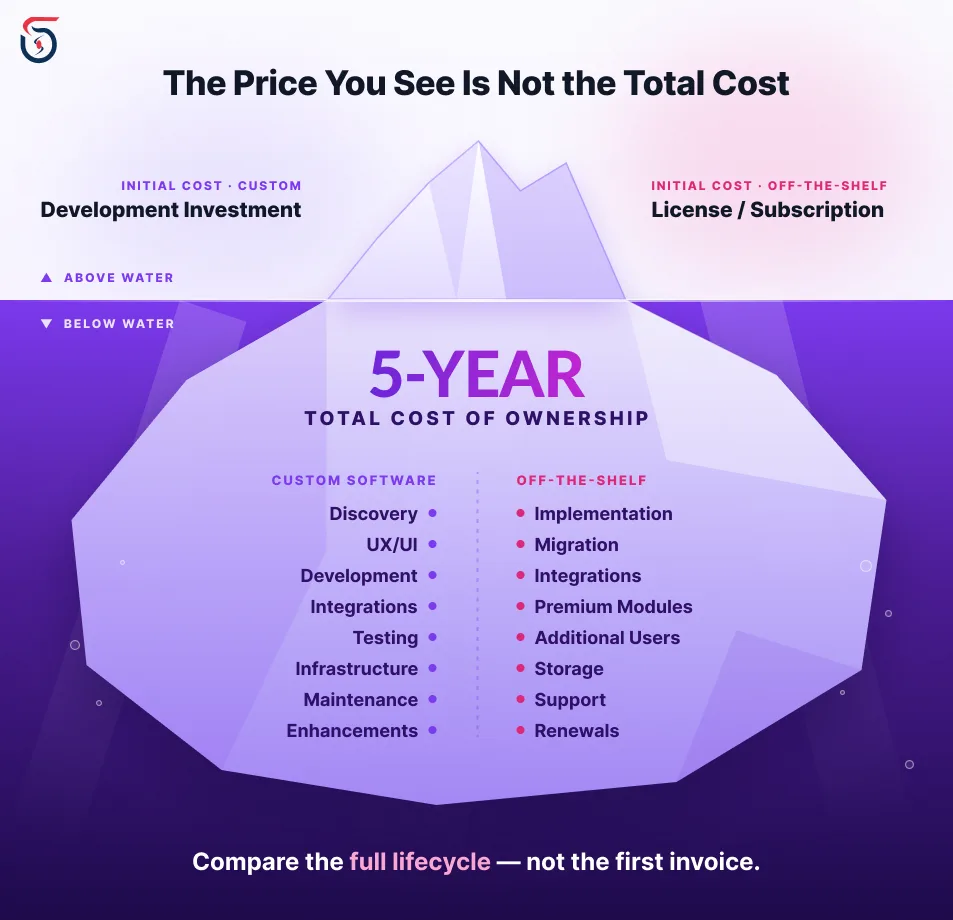
There is no universal price for custom software development in the USA. The cost depends on application scope, integrations, user experience, security requirements, architecture, development team, testing, infrastructure, and ongoing support.
Current Clutch data, based on verified project reviews, reports an average software development project cost of about $132,480 and an average project timeline of about 13 months. Clutch also reports typical development-company rates of $25–$49 per hour. These figures cover software development projects represented in its review dataset and should not be treated as a fixed US custom software price benchmark.
For a custom project, your budget should account for:
◆Discovery and requirements
◆UX/UI design
◆Development
◆APIs and third-party integrations
◆Testing and quality assurance
◆Security controls
◆Cloud infrastructure
◆Deployment
◆Maintenance and support
◆Future enhancements
Off-the-shelf software typically has a different cost structure. In addition to the license or subscription, businesses may pay for implementation, migration, integrations, premium modules, additional users, storage, support, and usage-based features.
This makes build vs buy software a five-year financial decision rather than simply an upfront-cost decision.
An Illustrative Five-Year Example
Consider two hypothetical businesses using a workflow application.
Business A - 50 users: An established SaaS product meets most requirements, requires limited configuration, and has straightforward integrations. Its recurring subscription and implementation costs may make buying practical.
Business B - 250 users: The organization has a highly specialized workflow, several internal integrations, and growing usage. A custom application may justify its larger initial investment if it eliminates significant manual work and avoids increasing licensing or customization costs.
These examples are illustrative, not market-price benchmarks. User count alone does not determine whether custom software becomes more economical. Compare the five-year total of development, subscriptions, integrations, maintenance, support, infrastructure, migration, and upgrades.
SaaS pricing can also become more complex over time. Zylo's 2026 SaaS Management Index reports that 78% of surveyed IT leaders experienced unexpected charges associated with AI features or consumption-based pricing during the previous year.
Speed, Flexibility, and Business Fit
One of the most obvious distinctions between the two methods is speed.
Off-the-shelf software can often be configured and deployed much faster when the business process already matches the product. Custom software normally requires discovery, architecture, design, development, testing, deployment, and user adoption, so the timeline can range from several months to considerably longer depending on complexity.
Instead of assuming that custom software takes a fixed number of months, evaluate the actual scope.
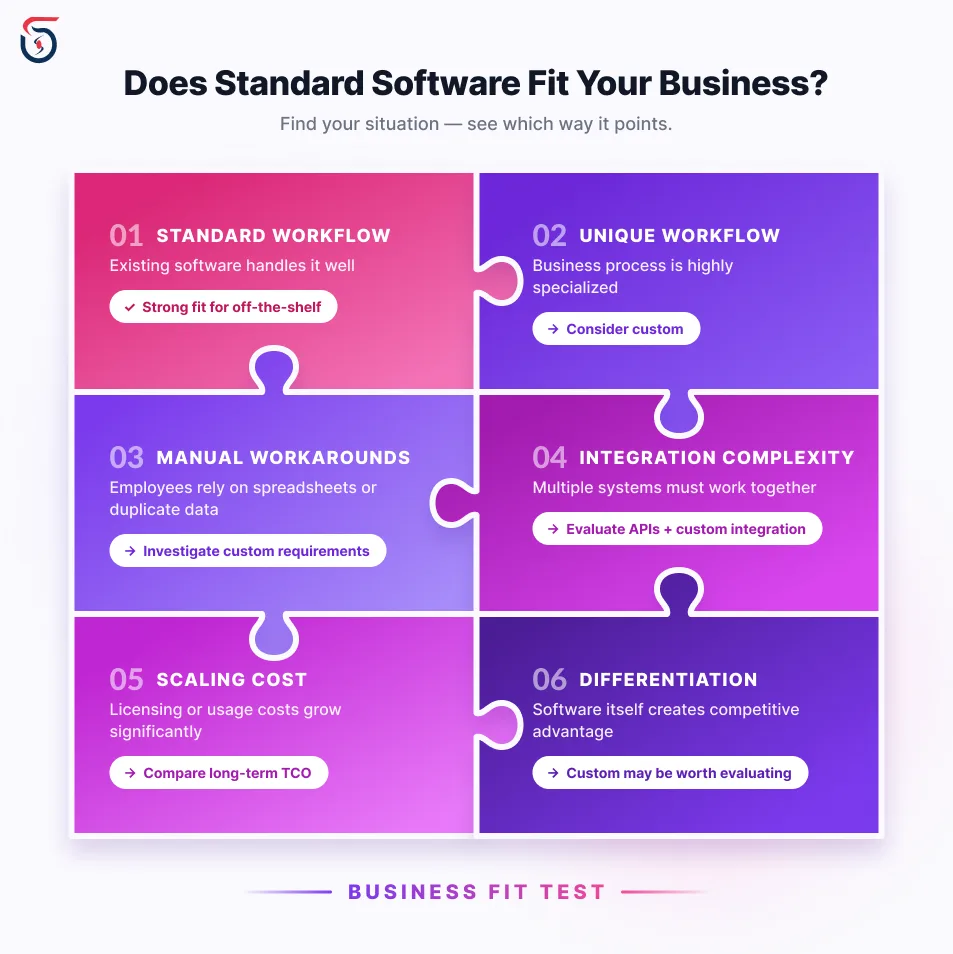
A packaged product may stop being a good fit when employees rely on spreadsheets to complete missing functions, manually transfer data between systems, duplicate records, or create workarounds around vendor limitations.
Before buying, test the product against your actual business process, not just the vendor's demo workflow. A feature that looks adequate during a sales demonstration may require expensive customization once real data, approvals, integrations, and security requirements are introduced.
For a small business evaluating whether custom software is a worthwhile investment, the starting point should be its potential business value. Consider whether it addresses a critical operational challenge that off-the-shelf solutions cannot handle effectively.
Security, Compliance, and Risk
Security should be evaluated in both build and buy decisions.
For off-the-shelf software, ask vendors for relevant security documentation, including a SOC 2 report where applicable. SOC 2 examinations address controls relevant to security, availability, processing integrity, confidentiality, or privacy.
For healthcare organizations, determine whether the vendor needs access to protected health information and whether a HIPAA-compliant Business Associate Agreement (BAA) is required. HHS states that a cloud service provider handling ePHI on behalf of a covered entity or business associate generally requires a HIPAA-compliant BAA.
Custom software allows security and compliance requirements to be incorporated into the architecture, but custom does not automatically mean more secure. The organization and development partner still have responsibility for secure coding, identity management, encryption, testing, monitoring, vulnerability management, and evidence of controls.
Custom development also introduces risks such as scope creep, integration complexity, maintenance responsibility, and dependency on a development partner.
Large technology projects can carry significant delivery risk. McKinsey and the University of Oxford found that IT projects with initial price tags above $15 million averaged 45% cost overruns and 7% schedule overruns in their research. These figures apply to large IT projects and should not be treated as a benchmark for typical SMB custom-software projects.
Off-the-shelf software has different risks, including vendor lock-in, renewal changes, roadmap decisions outside your control, feature limitations, and data-exit challenges. Before signing, confirm data export, API access, intellectual-property terms, retention, and termination provisions.
For organizations evaluating these issues, cybersecurity services can be considered alongside the software-selection process.
◆The available product already meets most functional requirements.
◆Your budget favors predictable subscription or licensing costs.
◆You do not need software functionality to differentiate your business.
◆Required integrations and security controls are already available.
For common business functions, buying an established product can avoid the time and responsibility involved in designing, building, testing, and maintaining an application.
When Should You Build Custom Software?
Custom software may be worth evaluating when:
◆Your workflow is strategically important or unique.
◆Existing products require extensive workarounds.
◆You need specialized integrations.
◆Your business model does not fit standard software.
◆Licensing or usage costs could become significant at scale.
◆You need greater control over functionality and the product roadmap.
◆Legacy systems require specialized modernization or integration.
The question is not simply "Can we build this?" Almost anything can be built with enough time and resources. The more important question is whether the resulting business value justifies the investment and ongoing ownership responsibilities.
The Hybrid Software Approach: Buy the Commodity, Build the Differentiator
You do not always have to choose between entirely custom software and entirely off-the-shelf software.
A hybrid software approach uses established products for commodity functions while custom applications handle workflows that provide operational or competitive differentiation.
For example, an organization could use an existing CRM, accounting system, or collaboration platform while developing a custom operations application that connects those systems through APIs.
Before adopting this approach, check:
◆API availability and limits
◆Webhook support
◆Data export options
◆Authentication methods
◆Integration costs
◆Data ownership
◆Contract termination terms
This can provide a practical path for organizations that want customization without rebuilding every business system.
Custom Software vs Off-the-Shelf Software: Quick Decision Checklist
Answer these five questions:
◆1. Does existing software support most of our core workflow?
◆2. Do we need functionality that multiple vendors cannot provide?
◆3. Are manual workarounds creating measurable cost, delays, or risk?
◆4. Could licensing or usage costs increase significantly as we scale?
◆5. Do we have the budget, ownership, and resources to maintain custom software?
How to Read the Results
◆Mostly Yes to #1 → evaluate off-the-shelf options first.
◆Mostly Yes to #2-4 → evaluate custom development.
◆A mixture of answers → investigate hybrid architecture.

The goal is not to produce a mathematical score. It is to identify which requirements deserve deeper financial and technical analysis.
Never Miss an Update
Add SoftSages Technology as a Preferred Source on Google for more of our latest tech content in AI Mode and AI Overviews.
Build, Buy, or Combine? Start With the Business Case
The right choice in the custom software vs off-the-shelf software decision depends on your workflow, growth plans, integration requirements, security needs, and five-year total cost. SoftSages Technology can help evaluate those factors and if an existing product is the better fit, we'll tell you that too.
Still deciding between build and buy? SoftSages Technology can evaluate your workflow, integrations, security requirements, and long-term costs and help determine whether buying, building, or combining both approaches makes sense.
Table of contents
What Is Off-the-Shelf Software vs Custom Software?
Custom Software vs Off-the-Shelf Software: Side-by-Side Comparison
What Does Each Option Really Cost?
Speed, Flexibility, and Business Fit
Security, Compliance, and Risk
When Should You Choose Off-the-Shelf Software?
When Should You Build Custom Software?
The Hybrid Software Approach: Buy the Commodity, Build the Differentiator
Custom Software vs Off-the-Shelf Software: Quick Decision Checklist
Build, Buy, or Combine? Start With the Business Case
Join Our Newsletter
Get the latest tech trends, tutorials and expert analysis delivered straight to your inbox.
FAQs About Custom Software vs Off-the-Shelf Software
Neither option is universally better. Off-the-shelf software generally suits standardized processes and faster deployment, while custom software can be appropriate for specialized workflows, integrations, scalability, or greater control. The right choice depends on requirements, budget, timeline, security needs, and long-term ownership.
Custom software development costs in the USA vary significantly based on scope, integrations, security, complexity, and team composition. Focused applications may cost tens of thousands of dollars, while complex platforms can reach hundreds of thousands or more. A discovery process is normally required for a meaningful estimate.
A small, focused application may take a few months, while complex platforms can require substantially longer. Requirements, integrations, security, testing, migration, and organizational approvals affect the timeline. Clutch's current reviewed-project data reports an average software development project timeline of about 13 months, but this should not be treated as a universal duration.
Sometimes, but not automatically. Custom software has higher upfront development costs but may provide greater control over functionality and licensing. SaaS usually has lower initial costs but recurring subscription, usage, integration, and renewal expenses. Compare five-year total cost rather than the initial price alone.
Yes. Organizations can start with packaged software and later develop custom systems when workflows, scale, or integration requirements outgrow the product. Planning for data portability, APIs, and integration boundaries early can make a future transition easier.