SoftSages company logo
LinkedIn professional network iconFacebook social media icon

How AI Is Transforming Industries in 2026 and Beyond
June 05, 2026 15 mins read SoftSages Team AI and ML Development
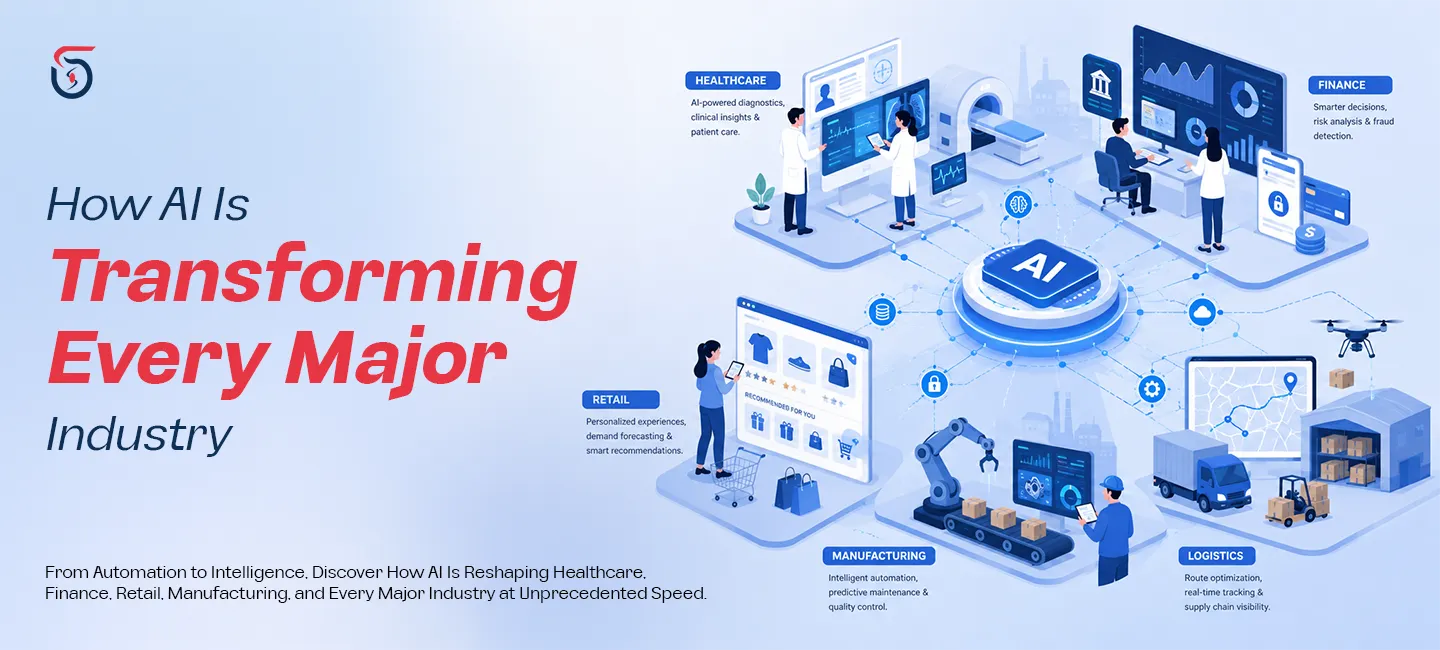
Artificial intelligence transforming modern industries

1. The Scale of AI Adoption Across Industries


2. The Common Thread: What Makes AI Transformative Across Every Industry


3. Challenges and Ethical Considerations


4. Emerging Industries AI Will Transform Next


5. Common AI Adoption Mistakes Businesses Should Avoid


6. How Businesses Can Start Their AI Transformation Journey


7. Conclusion: The AI Transformation Is Already Underway

Artificial intelligence is no longer a futuristic concept reserved for research labs and science fiction. Today, how AI is transforming industries is one of the most important conversations happening in boardrooms, startups, hospitals, factories, and financial institutions worldwide. From automating repetitive tasks to predicting market behavior with remarkable accuracy, AI is fundamentally reshaping how businesses operate, compete, and deliver value.
The question is no longer whether AI will impact your industry - it already has. The real question is how deeply you understand that transformation and how prepared your organization is to move with it rather than against it.
This article explores the most significant ways artificial intelligence is driving change across key industries, backed by real examples and actionable insights.

The Scale of AI Adoption Across Industries

Before diving into specific sectors, it helps to appreciate the scale at which AI adoption is happening globally. According to McKinsey's 2024 AI Report, approximately 72% of organizations have adopted AI in at least one business function - up from just 20% in 2017. Global AI investment reached over $91 billion in 2023, with projections pointing toward $200 billion by 2025.
This isn't speculative growth. It reflects a genuine shift in how industries use data, automate decisions, and build competitive advantages.
Here's a look at the sectors experiencing the most profound AI-driven transformation right now.

1. Healthcare: From Diagnosis to Drug Discovery

Healthcare industry is one of the most exciting frontiers for AI - and arguably one where the stakes are highest. How AI is transforming industries like healthcare goes beyond administrative efficiency; it is directly improving patient outcomes.

AI-Powered Diagnostics

Machine learning models can now analyze medical images - X-rays, MRIs, CT scans - with accuracy that rivals, and in some cases exceeds, experienced radiologists. Google's DeepMind developed an AI system capable of detecting over 50 eye diseases from retinal scans with expert-level precision.

Accelerating Drug Discovery

Traditional drug development takes 10 to 15 years and costs billions. AI-driven platforms like Insilico Medicine and BenevolentAI use deep learning to identify promising drug candidates in months rather than decades. In 2023, an AI-designed drug entered Phase II clinical trials - the first of its kind in history.

Predictive Patient Care

Hospitals are using AI to predict patient deterioration before it happens. Predictive models analyze vitals, lab results, and medical history in real time to flag high-risk patients, enabling early interventions that save lives and reduce ICU admissions.
Key impact: Faster diagnoses, reduced costs, earlier interventions, and life-saving drug discovery timelines.

2. Finance and Banking: Smarter Risk, Faster Decisions

The financial industry has been an early and aggressive adopter of AI - and for good reason. Speed, precision, and risk management are the core pillars of finance, and AI strengthens all three.

Fraud Detection and Prevention

AI-powered fraud detection systems analyze millions of transactions per second, identifying unusual patterns that human analysts would never catch in real time. Banks like JPMorgan Chase and HSBC deploy machine learning models that reduce false positives while catching fraudulent transactions before they are processed.

Algorithmic Trading

High-frequency trading firms have used algorithmic systems for years, but modern AI takes this further by processing unstructured data - news articles, social media sentiment, earnings call transcripts - to make trading decisions at speeds no human trader can match.

Credit Scoring and Lending

Traditional credit scoring relies on a narrow set of factors. AI models can analyze hundreds of variables - including alternative data like utility payments and behavioral patterns - to produce fairer, more accurate credit risk assessments. This is expanding access to credit for underserved populations globally.

AI-Powered Chatbots for Customer Service

Virtual financial assistants like Bank of America's Erica handle over a billion customer interactions per year, answering questions, flagging spending patterns, and guiding customers through financial decisions 24/7.
Key impact: Lower fraud losses, democratized access to credit, faster decision-making, and improved customer experience.

3. Manufacturing: The Smart Factory Revolution

Manufacturing is experiencing what many analysts call Industry 4.0 - and AI is the engine driving it. How AI is transforming industries in the manufacturing sector comes down to three core areas: predictive maintenance, quality control, and supply chain optimization.

Predictive Maintenance

Instead of servicing equipment on a fixed schedule (which leads to either over-maintenance or unexpected failures), AI systems monitor machines in real time using IoT sensors. Algorithms detect early signs of wear or malfunction before breakdowns occur. Siemens reports that predictive maintenance powered by AI reduces unplanned downtime by up to 50%.

AI-Driven Quality Control

Computer vision systems inspect products on assembly lines at superhuman speed and accuracy. They detect microscopic defects in manufactured components that human inspectors would routinely miss, reducing waste and recall risks significantly.

Supply Chain Optimization

AI is enabling manufacturers to build more resilient and responsive supply chains. Demand forecasting models powered by machine learning factor in seasonal trends, economic signals, and supplier performance to optimize inventory levels and prevent costly stockouts or overproduction.
Key impact: Reduced downtime, lower production costs, higher product quality, and stronger supply chain resilience.

4. Retail and E-Commerce: Hyper-Personalization at Scale

Retail has undergone one of the most visible AI-driven transformations of any sector. The shift from generic mass marketing to highly personalized experiences is almost entirely driven by artificial intelligence.

Recommendation Engines

Netflix, Amazon, and Spotify have popularized AI-powered recommendation systems, but this technology now extends across all retail. Personalized product recommendations account for approximately 35% of Amazon's total revenue - a testament to the business impact of getting personalization right.

Dynamic Pricing

Airlines, hotels, and e-commerce platforms use AI to adjust prices in real time based on demand, competitor pricing, inventory levels, and customer behavior. Dynamic pricing helps businesses maximize revenue while remaining competitive.

Inventory and Demand Forecasting

Retail giants like Walmart and Zara use AI to predict which products will be in demand by region, season, and consumer demographic. This minimizes overstocking and markdowns, dramatically improving profit margins.

AI in Customer Support

Conversational AI handles the majority of tier-1 customer support queries - order tracking, return processing, product questions - freeing human agents to focus on complex issues requiring genuine empathy and judgment.
Key impact: Higher conversion rates, improved customer retention, reduced operational costs, and smarter inventory management.
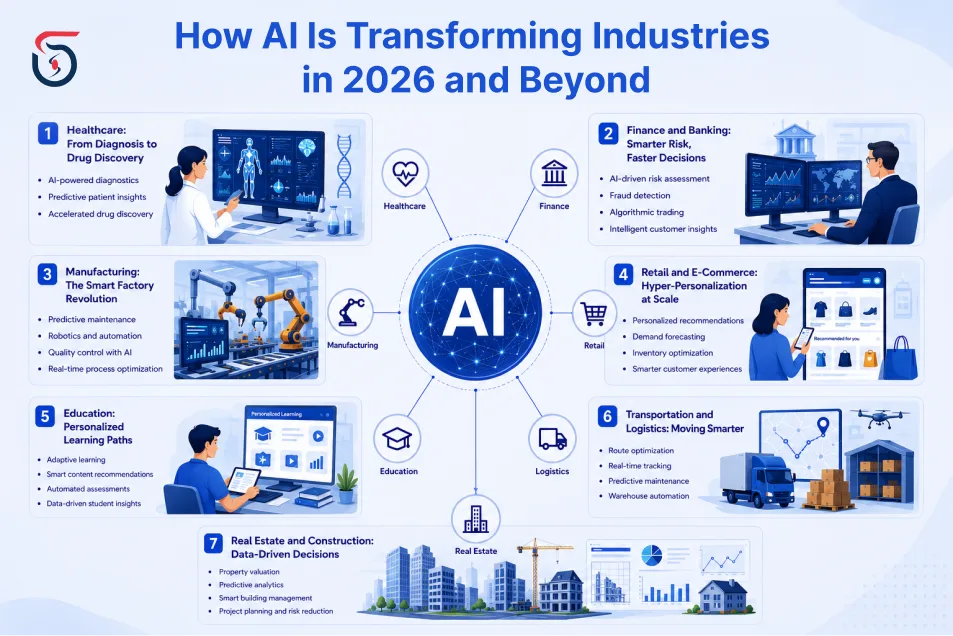
AI use cases across industries including predictive analytics, automation, personalized learning, and smart logistics.

5. Education: Personalized Learning Paths

The education sector is beginning a deep transformation as AI moves from administrative tools into the core of how students learn.

Adaptive Learning Platforms

AI-powered platforms like Khan Academy, Coursera, and Duolingo analyze how individual students learn - their pace, error patterns, and areas of strength - and dynamically adjust content to match their unique needs. This delivers personalized education at a scale no human teacher could replicate alone.

Automated Assessment and Feedback

AI tools now grade essays, code submissions, and problem sets with remarkable accuracy, providing students with instant, detailed feedback. This dramatically accelerates the learning loop and reduces the grading burden on educators.

Early Identification of At-Risk Students

Educational institutions are using predictive analytics to identify students at risk of falling behind or dropping out - enabling counselors and teachers to intervene earlier and more effectively.
Key impact: More equitable access to quality education, faster student progress, and better outcomes at scale.

6. Transportation and Logistics: Moving Smarter

How AI is transforming industries in transportation goes from last-mile delivery optimization all the way to fully autonomous vehicles.

Autonomous Vehicles

Companies like Waymo, Tesla, and Cruise are developing self-driving vehicle technology that could fundamentally eliminate human error as the leading cause of road accidents. While full autonomy is still evolving, autonomous trucking for highway freight is already in commercial operation in parts of the United States.

Route and Fleet Optimization

AI systems analyze real-time traffic, weather, delivery windows, and vehicle capacity to generate optimized routes that reduce fuel consumption and delivery time. UPS reports saving over 10 million gallons of fuel annually through its AI-driven routing system, ORION.

Drone and Robotic Delivery

Amazon, DHL, and Zipline are deploying AI-guided drones and autonomous robots for last-mile and medical deliveries, reducing costs and reaching underserved locations more efficiently.
Key impact: Lower logistics costs, faster delivery, improved road safety, and reduced carbon emissions.

7. Real Estate and Construction: Data-Driven Decisions

AI is transforming real estate and construction in ways that affect buyers, sellers, investors, and developers alike.
  • Property Valuation: AI models analyze thousands of variables - location, market trends, comparable sales, infrastructure developments - to produce precise property valuations in seconds.
  • Predictive Market Analytics: Investors use AI to identify emerging real estate markets before they peak, gaining a significant competitive edge.
  • Construction Safety: Computer vision systems monitor construction sites to detect safety violations and unsafe behavior in real time, reducing workplace accidents.

The Common Thread: What Makes AI Transformative Across Every Industry
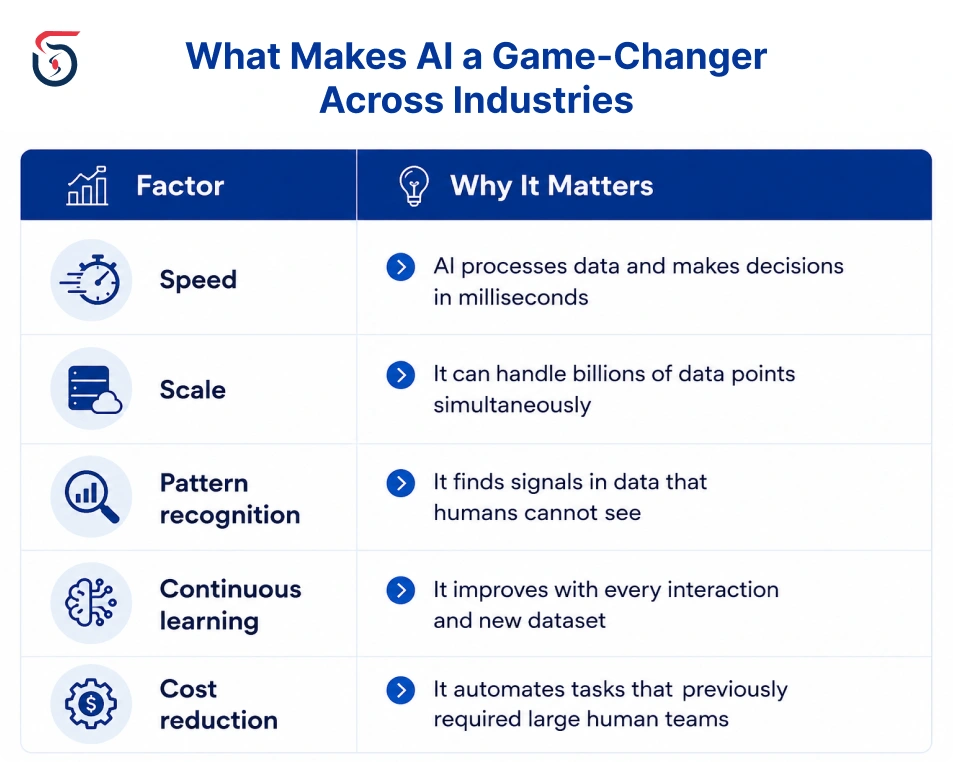
While the specific applications vary by sector, the underlying reasons AI is so transformative are consistent:
Benefits of AI transformation across industries
These capabilities do not replace human judgment - they amplify it. The most successful organizations are those that combine AI's analytical power with human creativity, empathy, and strategic thinking.

Challenges and Ethical Considerations

No discussion of how AI is transforming industries would be complete without acknowledging the real challenges organizations face:
  • Data privacy and security - AI systems require massive datasets, raising significant concerns around how personal data is collected, stored, and used.
  • Algorithmic bias - AI models trained on biased data produce biased outcomes, which can perpetuate inequalities in hiring, lending, and healthcare.
  • Workforce displacement - Automation is changing the nature of work. While AI creates new roles, it also displaces others, requiring thoughtful transition planning.
  • Regulatory compliance - Governments worldwide are introducing AI regulation (notably the EU AI Act), and businesses must stay ahead of compliance requirements.
Organizations that take these challenges seriously - building responsible, explainable AI systems - will earn the trust of customers and regulators alike.

Emerging Industries AI Will Transform Next

The industries already covered represent where AI has firmly taken hold. But a second wave of transformation is accelerating fast - and these sectors are next in line.
  • Legal: AI is automating contract review, accelerating legal research, improving compliance monitoring, and helping firms analyze litigation risks more efficiently.
  • Agriculture: AI is optimizing irrigation, crop planning, pest detection, and autonomous farming operations to improve productivity and reduce waste.
  • Cybersecurity: AI is strengthening cybersecurity through real-time threat detection, phishing prevention, anomaly monitoring, and automated incident response.
  • Energy: AI is helping energy providers improve grid balancing, demand forecasting, predictive maintenance, and renewable energy management.
  • Insurance: AI is transforming underwriting, claims processing, fraud detection, and personalized policy pricing with faster and more accurate risk analysis.
  • Human Resources: AI is improving recruitment, workforce planning, employee retention, sentiment analysis, and personalized learning and development programs.

Common AI Adoption Mistakes Businesses Should Avoid
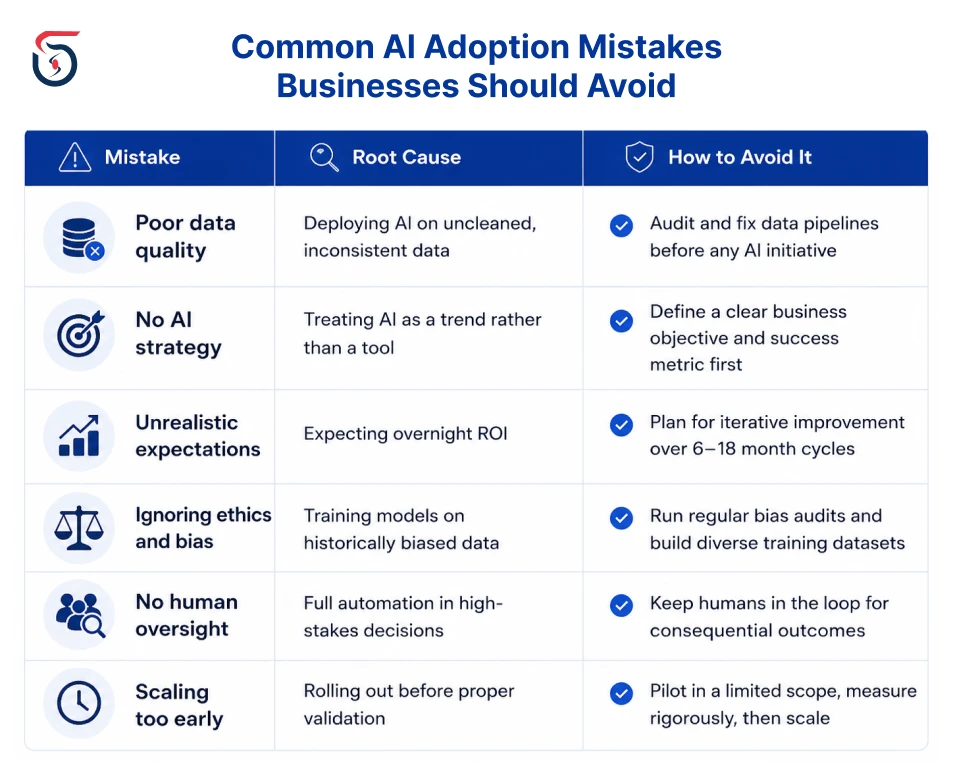
AI failures in business are rarely caused by the technology itself - they are almost always the result of poor planning, misaligned expectations, or shortcuts taken during implementation. Understanding these pitfalls before you begin can save your organization significant time, money, and credibility.
Common AI adoption mistakes businesses should avoid during implementation

How Businesses Can Start Their AI Transformation Journey

If your organization is still exploring where to begin, here is a practical roadmap:
  • Audit your data infrastructure - AI is only as good as the data feeding it. Clean, accessible, well-structured data is the foundation.
  • Identify high-impact use cases - Start with processes where AI can deliver measurable ROI quickly: customer support automation, predictive analytics, or process optimization.
  • Build cross-functional AI teams - Successful AI adoption requires collaboration between data scientists, domain experts, and business leaders.
  • Pilot before scaling - Run controlled pilots to validate AI solutions before rolling them out at enterprise scale.
  • Invest in talent and training - Upskilling your existing workforce is just as important as hiring AI specialists.

Conclusion: The AI Transformation Is Already Underway

Understanding how AI is transforming industries is not just an intellectual exercise - it's a business imperative. The organizations thriving in 2025 and beyond are not the ones with the largest budgets or the most employees. They are the ones making smarter, faster, data-driven decisions powered by artificial intelligence.
Every industry covered in this guide - healthcare, finance, manufacturing, retail, education, transportation, and real estate - is being reshaped by the same fundamental shift: the ability to extract intelligence from data at a scale and speed no human team can match.
The competitive advantage belongs to those who act now - not those who wait for the technology to mature further.

Looking for an experienced AI consulting company to help your business adopt artificial intelligence strategically? SoftSages builds scalable AI-powered solutions for healthcare, finance, retail, logistics, and enterprise operations.

Table of contents

The Scale of AI Adoption Across Industries


The Common Thread: What Makes AI Transformative Across Every Industry


Challenges and Ethical Considerations


Emerging Industries AI Will Transform Next


Common AI Adoption Mistakes Businesses Should Avoid


How Businesses Can Start Their AI Transformation Journey


Conclusion: The AI Transformation Is Already Underway

Join Our Newsletter

Get the latest tech trends, tutorials and expert analysis delivered straight to your inbox.

FAQs about How AI Is Transforming Industries

Healthcare, finance, and manufacturing are consistently cited as the most AI-transformed industries. Healthcare benefits from AI diagnostics and drug discovery, finance leverages AI for fraud detection and trading, and manufacturing uses AI for predictive maintenance and quality control. Each sector's transformation is driven by the unique value AI brings to their core operations.

AI is automating repetitive, rule-based tasks while creating demand for new roles in data science, AI ethics, machine learning engineering, and AI-augmented decision-making. Rather than eliminating work entirely, most studies suggest AI shifts the nature of jobs - requiring workers to develop new skills focused on working alongside intelligent systems.

No. AI tools and platforms have become significantly more accessible in recent years. Cloud-based AI services from AWS, Google Cloud, and Microsoft Azure allow small and mid-sized businesses to access enterprise-grade AI capabilities without large upfront infrastructure investment.

The main risks include data privacy concerns, algorithmic bias, over-reliance on automated decision-making without human oversight, cybersecurity vulnerabilities, and regulatory compliance challenges. Organizations that implement AI responsibly - with proper governance frameworks - can manage these risks effectively.

It depends on scope. Simple AI integrations - like deploying a chatbot or a recommendation engine - can be live in weeks. More complex systems involving custom model development, large-scale data pipelines, and enterprise integration typically take 6 to 18 months to deploy fully.

Traditional automation executes predefined rules without the ability to adapt. AI goes further - it learns from data, improves over time, recognizes patterns, and makes decisions in ambiguous situations. Automation is rigid; AI is adaptive. Most modern systems combine both for maximum efficiency.

Healthcare, finance, transportation, and cybersecurity are expected to see the biggest AI-driven changes. AI is improving diagnostics, fraud detection, autonomous vehicles, threat detection, and operational efficiency across these industries.

Yes. Small businesses can use affordable AI tools for chatbots, marketing automation, customer support, analytics, and workflow automation. Cloud-based AI platforms make adoption easier without large upfront investments.

Businesses use AI for chatbots, recommendation engines, predictive analytics, CRM insights, automated customer support, fraud detection, inventory forecasting, and process automation to improve efficiency and customer experience.