


Monolithic vs Microservices Architecture Comparison Guide
1. What is Monolithic Architecture?
2. What is Microservices Architecture?
3. Why the Choice Between Monolith and Microservices Matters More Than Ever
4. Monolithic vs Microservices Architecture: Direct Comparison
5. Breaking Down the Key Differences
6. When to Choose Monolithic Architecture
7. When to Choose Microservices Architecture
8. The Modular Monolith: The Middle Path Worth Considering
9. Common Mistakes to Avoid
10. Real-world Use Cases
11. To Wrap Up: Which Architecture Should You Choose?
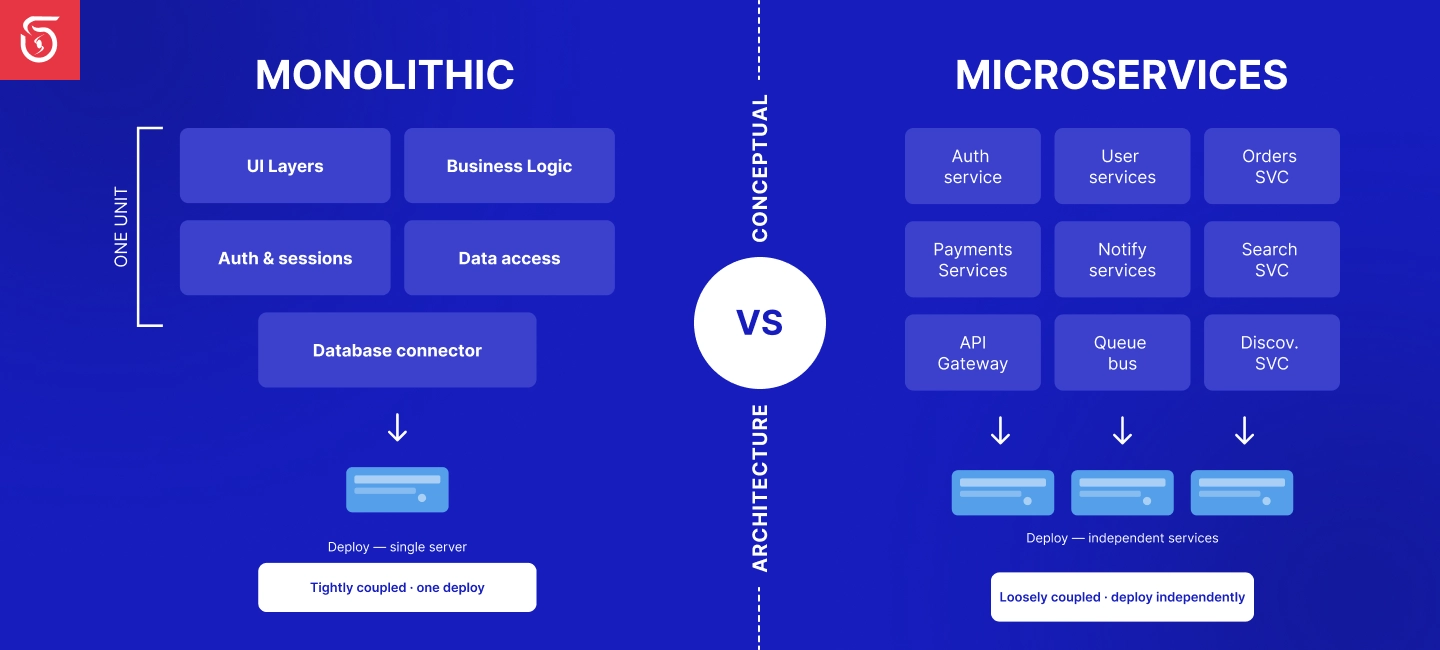
What is Monolithic Architecture?
- ◆Single deployable artifact
- ◆Shared memory and process space
- ◆Centralized database
- ◆Simpler local development setup
- ◆Tightly coupled components
What is Microservices Architecture?
- ◆Independent deployment per service
- ◆Decentralized data management
- ◆Technology heterogeneity (each service can use different languages or databases)
- ◆Higher operational complexity
- ◆Built for scale and fault isolation
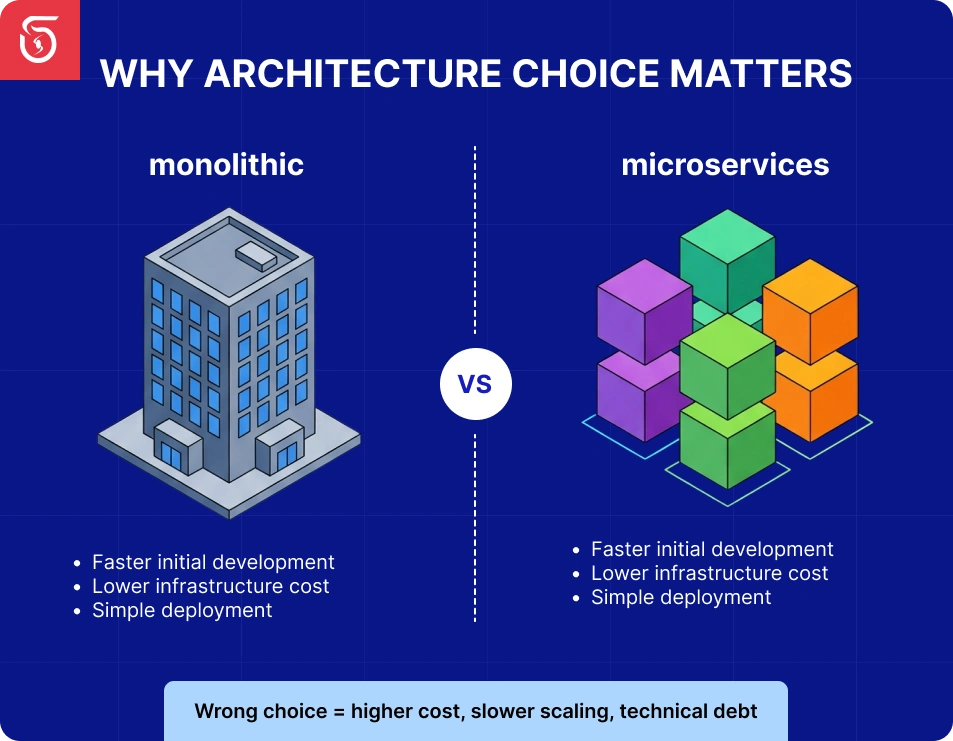
Why the Choice Between Monolith and Microservices Matters More Than Ever
Monolithic vs Microservices Architecture: Direct Comparison
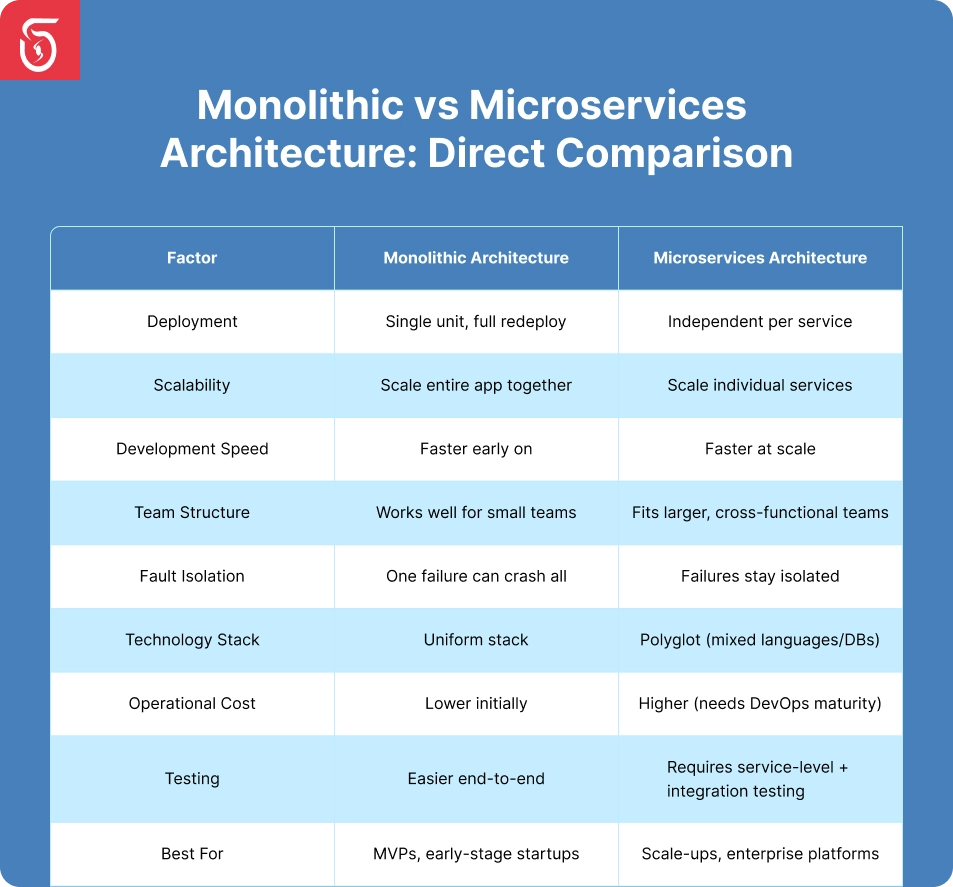
Breaking Down the Key Differences
1. Scalability
2. Development Velocity
3. Fault Tolerance
4. Operational Complexity
When to Choose Monolithic Architecture
- ◆You're building an MVP or proof of concept
- ◆Your team has fewer than 10 engineers
- ◆Domain boundaries are not yet well-defined
- ◆The key priority is bringing solutions to market faster.
- ◆Your product doesn't have high or uneven traffic patterns
When to Choose Microservices Architecture
- ◆Your product is scaling beyond a single team's ability to manage one codebase
- ◆Different features have drastically different scaling requirements
- ◆You need independent deployment without coordinating across teams
- ◆You're operating in a regulated or high-availability environment
- ◆Your infrastructure team is mature enough to manage Kubernetes, Docker, and observability tooling
The Modular Monolith: The Middle Path Worth Considering
Common Mistakes to Avoid
- ◆1. Microservices too early: Teams copy Netflix or Amazon without having their scale, team size, or operational maturity. The result: complex infrastructure with no meaningful benefit.
- ◆2. Ignoring domain boundaries: Bad service decomposition splitting by technological layers as opposed to business capabilities leads to chatty, tightly coupled services that defeat the purpose.
- ◆3. Shared databases in microservices: Each microservice must own its data store. Sharing a database between services reintroduces coupling and negates the independence of microservices promise.
- ◆4. Skipping observability: Without distributed tracing (Jaeger, Zipkin) and centralized logging (ELK Stack, Datadog), debugging across services becomes nearly impossible.
Real-world Use Cases
- ◆Monolith done right: A B2B SaaS company launched its core HR platform as a monolith. After two years, they had clear domain boundaries and broke out the payroll module as a microservice achieving targeted scalability without disrupting existing functionality.
- ◆Microservices done right: A high-growth e-commerce platform handling 500K+ daily transactions decomposed into 18 microservices across catalog, inventory, payments, and notifications each deployed independently via Kubernetes on Google Cloud, reducing deployment frequency from once a week to many times a day.
To Wrap Up: Which Architecture Should You Choose?
Design or migrate your product architecture with confidence through our advanced software architecture and cloud development services. Still debating monolith vs. microservices? and get an honest assessment from our engineering team.
Table of contents
What is Monolithic Architecture?
What is Microservices Architecture?
Why the Choice Between Monolith and Microservices Matters More Than Ever
Monolithic vs Microservices Architecture: Direct Comparison
Breaking Down the Key Differences
When to Choose Monolithic Architecture
When to Choose Microservices Architecture
The Modular Monolith: The Middle Path Worth Considering
Common Mistakes to Avoid
Real-world Use Cases
To Wrap Up: Which Architecture Should You Choose?
Join Our Newsletter
Get the latest tech trends, tutorials and expert analysis delivered straight to your inbox.
Monolithic vs Microservices Architecture FAQs
A monolithic architecture packages all application logic into a single deployable component, whereas microservices divide the application into independently deployable services. Monoliths are simpler to build early on; microservices offer better scalability and fault isolation at greater complexity and operational cost.
Startups should generally begin with a monolith to maximize development speed. Microservices become worthwhile when the team grows beyond 15–20 engineers; services have clearly distinct scaling needs, or independent deployment without cross-team coordination becomes critical.
Yes. Many companies, including Netflix and Uber started monoliths and migrated over time. A Modular Monolith is an effective intermediate step: it maintains a single deployment while structuring code into well-bounded modules that are easier to extract into services later.
Beyond infrastructure, microservices require investment in service discovery, API gateway management, distributed tracing, container orchestration (Kubernetes), and inter-service security. Teams without strong DevOps maturity often underestimate these operational costs significantly.
Not necessarily. Microservices enable granular, service-level scaling, which is highly efficient at scale. However, for small-to-medium traffic volumes, a well-optimized monolith can be equally performed without the complexity overhead of managing dozens of independent services.
Use monolithic for MVPs or small teams needing quick launches. Switch to microservices for high traffic, independent scaling, or large teams ideal for SaaS or fintech after 50K users. Assess via deployment frequency.
Leading technology companies including Netflix, Amazon, Uber, Google, and Meta operate on microservices architectures. These organizations have large engineering teams, well-defined domain boundaries, and mature DevOps infrastructure that makes microservices practical and effective at their scale.