


Generative AI vs Traditional AI: Key Differences and How to Choose
1. What Is Traditional AI?
2. What Is Generative AI?
3. Generative AI vs Traditional AI: The Core Differences
4. Where Each Approach Actually Wins in Practice
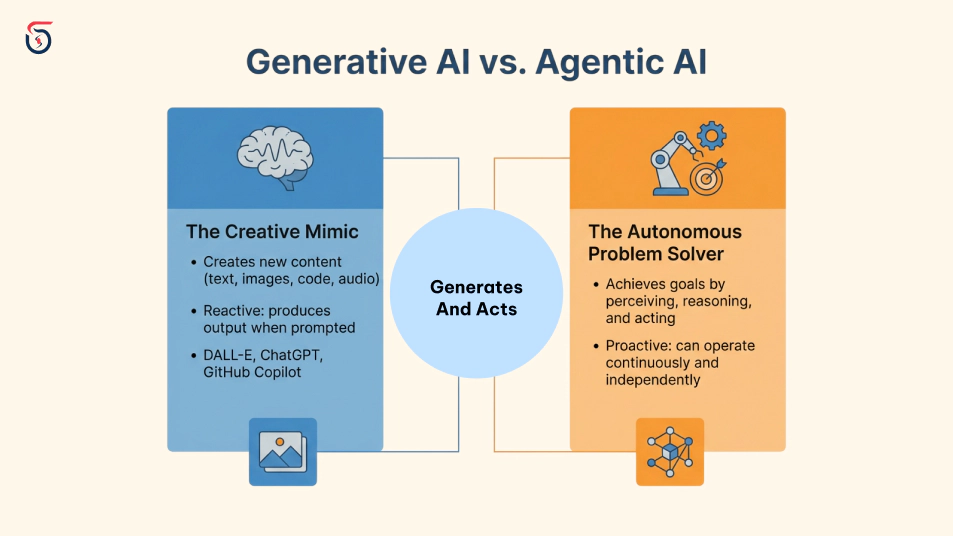
5. The Emerging Third Category: Agentic AI
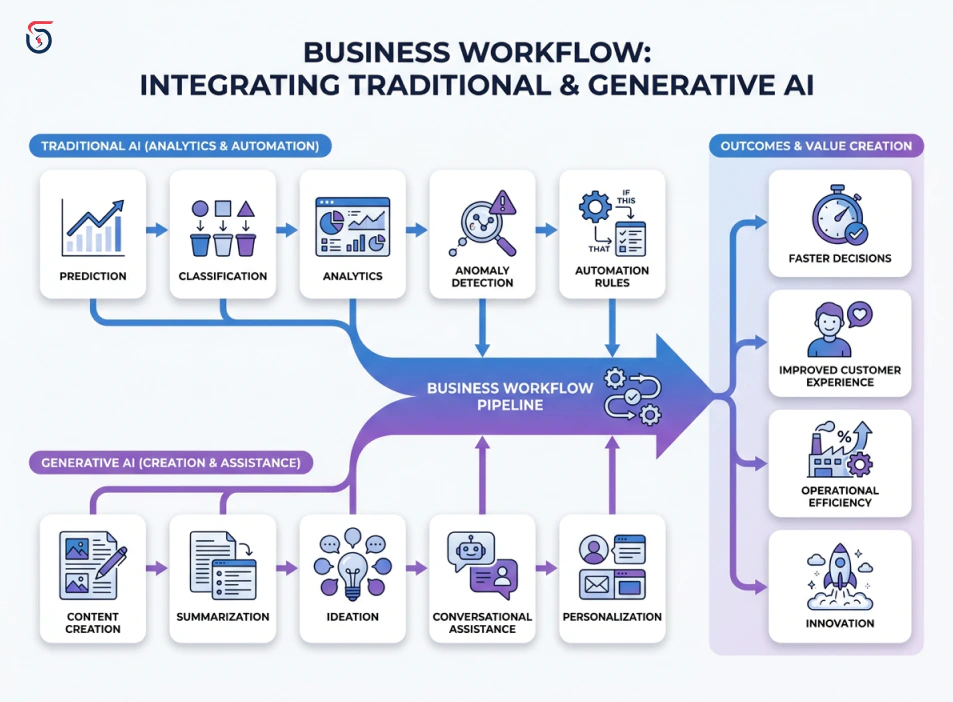
6. How Traditional AI and Generative AI Work Together
7. How to Decide Which Approach Your Business Needs
8. Choosing Between Generative AI and Traditional AI
What Is Traditional AI?
- ◆Rule- or model-based for a specific task. A churn-prediction model predicts churn — it doesn't write marketing copy or summarize a meeting.
- ◆Trained on structured, often historical data. They learn from past examples to make decisions about new, similar inputs.
- ◆Deterministic and explainable in most cases. It's usually possible to trace why a traditional AI model made a particular prediction, which matters a great deal in regulated industries.
What Is Generative AI?
- ◆Trained on vast, often unstructured datasets — text, images, code — rather than narrow, task-specific data.
- ◆Adaptive to new, open-ended problems without needing to be explicitly rebuilt for each one, since the underlying model has learned broad patterns rather than one fixed task.
- ◆Probabilistic rather than deterministic. Ask the same question twice and you may get two different, both reasonable, answers — a meaningful contrast with the more consistent output of traditional AI.
Generative AI vs Traditional AI: The Core Differences
| Factor | Traditional AI | Generative AI |
|---|---|---|
| Primary function | Analyzes, classifies, predicts | Creates new content |
| Output type | A label, score, or prediction | Text, image, audio, code, or other generated content |
| Data requirements | Structured, task-specific data | Vast, often unstructured data |
| Output consistency | Deterministic, repeatable | Probabilistic, can vary between runs |
| Explainability | Generally easier to trace and audit | Often a "black box" — harder to fully explain a specific output |
| Best suited for | Defined, repeatable, rule-bound problems | Open-ended, creative, or unstructured problems |
Where Each Approach Actually Wins in Practice
Traditional AI Wins When:
- ◆The task has a clear, measurable outcome to predict (will this customer churn, is this transaction fraudulent).
- ◆Explainability and auditability matter — for example, a credit-decisioning model in a regulated financial context.
- ◆The data is structured and the problem is well-bounded, with a defined and stable set of possible outcomes.
Generative AI Wins When:
- ◆The task involves producing original content — text, visuals, code — rather than scoring or sorting existing data.
- ◆The problem is genuinely open-ended, with no single "correct" output to optimize toward.
- ◆Speed and volume of first-draft creative output matters more than perfect precision on the first attempt.
A Practical Example
The Emerging Third Category: Agentic AI
How Traditional AI and Generative AI Work Together
- ◆A traditional AI model segments customers into groups based on behavior; generative AI then drafts personalized marketing content tailored to each segment.
- ◆A traditional AI model predicts which equipment is at risk of failure; generative AI drafts the maintenance report and recommended next steps for a technician to review.
- ◆A traditional AI model flags an anomalous network pattern; generative AI summarizes the incident in plain language for a security analyst who doesn't have time to read raw logs.
How to Decide Which Approach Your Business Needs
- ◆Define the actual output you need. A score, a classification, or a prediction points toward traditional AI. New content — written, visual, coded — points toward generative AI.
- ◆Check how much explainability you require. Regulated decisions (credit, hiring, medical diagnosis support) generally demand the more auditable, deterministic nature of traditional AI, at least for the decision itself.
- ◆Assess your data. Traditional AI tends to need clean, structured, task-specific historical data. Generative AI tools, especially pre-trained foundation models, can often be applied with far less custom training data through prompt engineering alone.
- ◆Consider whether the task is genuinely open-ended. If there's no single correct answer and creative variation is actually the point, that's squarely generative AI territory.
- ◆Don't assume it has to be one or the other. Most valuable enterprise AI strategies blend predictive and generative components across a single workflow rather than picking one model type for the whole business.
Choosing Between Generative AI and Traditional AI
Not sure whether your next AI project needs prediction, generation, or both? SoftSages helps businesses cut through the noise and build the right AI solution for the actual problem — whether that's a traditional predictive model, a generative AI-powered tool, or a combined, agentic workflow. 👉 Explore Our AI/ML Development Services and get a clear, no-pressure assessment of the right AI approach for your business.
Table of contents
What Is Traditional AI?
What Is Generative AI?
Generative AI vs Traditional AI: The Core Differences
Where Each Approach Actually Wins in Practice
The Emerging Third Category: Agentic AI
How Traditional AI and Generative AI Work Together
How to Decide Which Approach Your Business Needs
Choosing Between Generative AI and Traditional AI
Join Our Newsletter
Get the latest tech trends, tutorials and expert analysis delivered straight to your inbox.
FAQs about Generative AI vs Traditional AI
Traditional AI analyzes existing data to classify, predict, or detect patterns, while generative AI creates new content — text, images, code — by learning patterns from training data and producing original output.
Common examples include fraud detection systems, demand forecasting models, predictive maintenance tools, spam filters, and recommendation engines that rank existing items rather than generate new content.
Examples include AI chatbots like ChatGPT and Claude, AI image generators, code-generation tools like GitHub Copilot, and tools that draft marketing copy, summarize documents, or create synthetic data.
Neither is universally "better" — they solve different problems. Traditional AI is generally better for tasks needing explainable, consistent predictions, while generative AI is better suited to open-ended, creative content generation.
No. Generative AI cannot fully replace traditional AI, since many business problems — fraud detection, churn prediction, regulated decision-making — require the explainability and consistency traditional AI provides.
Agentic AI autonomously manages multi-step workflows and takes real actions on systems with minimal human input, while generative AI produces content for a human to review and act on. Agentic AI often uses generative AI components within a broader autonomous process.
Traditional AI is generally more explainable, since its decisions can often be traced back to specific data patterns. Generative AI models are typically more opaque, functioning as "black boxes" that are harder to fully interpret.
Many businesses use traditional AI to generate a prediction or classification, then use generative AI to turn that output into human-readable content, such as a personalized marketing message or an incident summary.
Generative AI models, particularly pre-trained foundation models, often require less custom task-specific data than traditional AI, since they can be applied to new problems through prompt engineering rather than full retraining.
Start by defining the actual output you need: a prediction or classification points to traditional AI, while new content or creative output points to generative AI. Many real workflows benefit from combining both.