


How to Choose the Right AI/ML Development Company in 2026
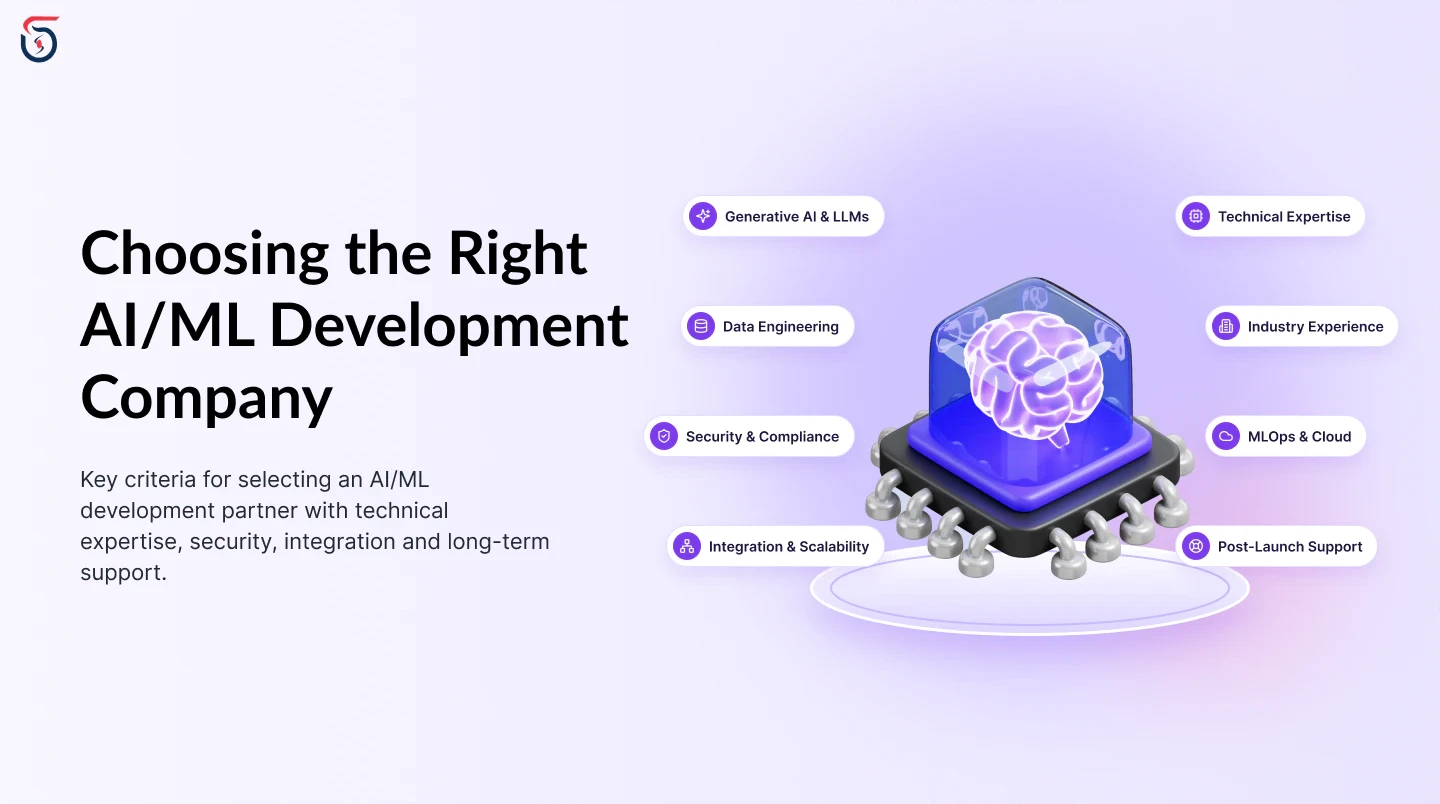
1. What Does an AI/ML Development Company Do?
2. 8 Factors to Consider When Choosing an AI/ML Development Company
3. How to Evaluate an AI/ML Development Company's Portfolio
4. Questions to Ask Before Hiring an AI/ML Development Company
5. Common Mistakes to Avoid
6. Making the Right Choice
What Does an AI/ML Development Company Do?
- ◆AI/ML Strategy and Development - Defining use cases, assessing feasibility, and road-mapping implementation.
- ◆Machine Learning Models - Building supervised, unsupervised, and reinforcement learning algorithms tailored to specific problems.
- ◆Generative AI and LLMs - Creating text, image, or code generation systems using large language models and diffusion techniques.
- ◆AI Agents - Designing autonomous software entities that perceive, decide, and act within digital environments.
- ◆NLP and Computer Vision - Enabling language understanding, sentiment analysis, object detection, and image classification.
- ◆Intelligent Automation - Embedding AI into RPA workflows to reduce manual effort and improve accuracy.
- ◆Deployment and Maintenance - Containerizing models, setting up CI/CD pipelines, monitoring performance, and iteratively refining solutions.
8 Factors to Consider When Choosing an AI/ML Development Company
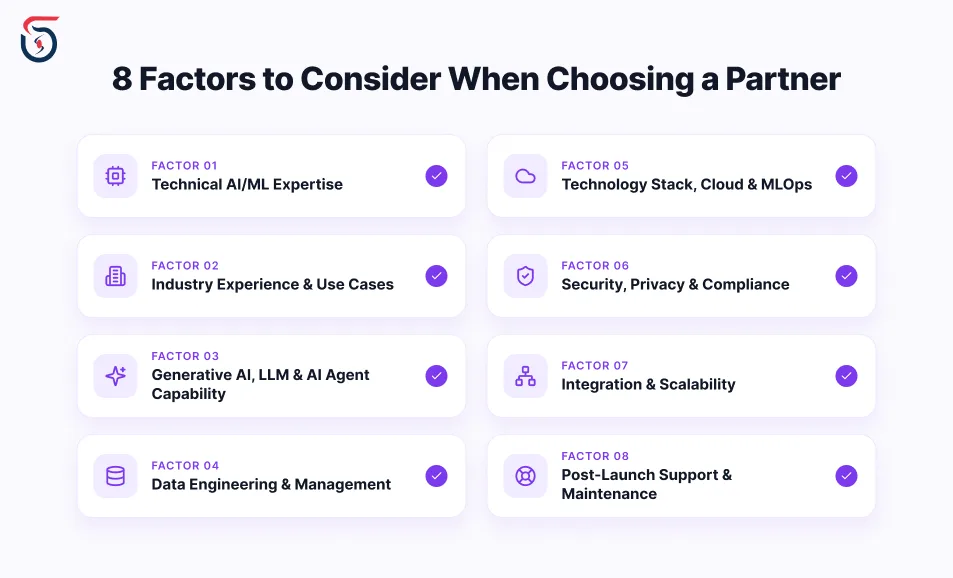
1. Technical AI/ML Expertise
2. Industry Experience and Relevant Use Cases
3. Generative AI, LLM and AI Agent Capabilities
4. Data Engineering and Data Management
5. Technology Stack, Cloud and MLOps
6. Security, Privacy and Compliance
7. Integration and Scalability
8. Post-Launch Support and Maintenance
How to Evaluate an AI/ML Development Company's Portfolio
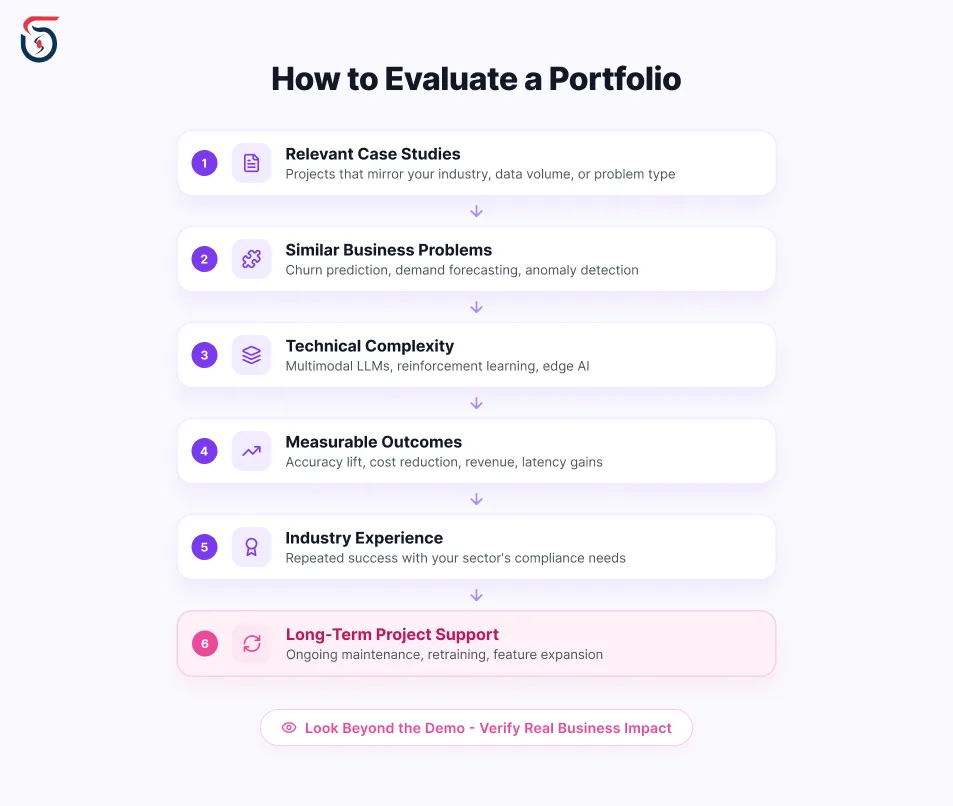
- ◆Relevant Case Studies: Projects that mirror your industry, data volume, or problem type.
- ◆Similar Business Problems: Look for objectives like churn prediction, demand forecasting, or anomaly detection that align with your goals.
- ◆Technical Complexity: Evidence of advanced techniques (e.g., multimodal LLMs, reinforcement learning, and edge AI) indicates depth.
- ◆Measurable Outcomes: Quantifiable KPIs such as % accuracy lift, cost reduction, revenue increase, or latency improvement.
- ◆Industry Experience: Repeated success within your sector signals familiarity with compliance and operational nuances.
- ◆Long-Term Project Support: References to ongoing maintenance, model retraining, or feature expansion demonstrate commitment beyond delivery.
Questions to Ask Before Hiring an AI/ML Development Company
- ◆What AI/ML projects have you delivered? - Request specifics on scope, technologies, and results.
- ◆Do you have experience in our industry? - Verify domain relevance and regulatory awareness.
- ◆How do you handle data preparation? - Explore ETL pipelines, data quality checks, and feature engineering practices.
- ◆What AI/ML technologies do you use? - Confirm familiarity with preferred frameworks, LLMs, and MLOps tools.
- ◆Can you integrate AI with our existing systems? - Discuss API design, middleware, and legacy compatibility.
- ◆How do you handle security and compliance? - Inquire about certifications, encryption, audit logs, and data-processing agreements.
- ◆What support is provided after deployment? - Clarify SLAs, retraining frequency, and issue-resolution processes.
- ◆How will you measure project success? - Ensure alignment on KPIs, baseline metrics, and reporting cadence.
Common Mistakes to Avoid
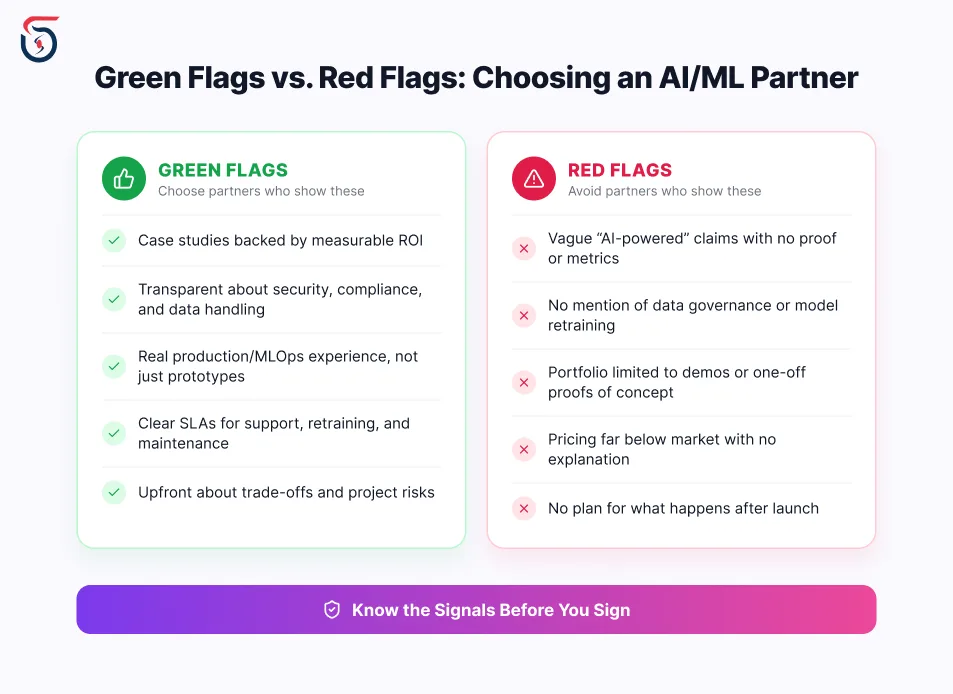
- ◆Choosing based only on price - Low bids often mask limited expertise or hidden costs later.
- ◆Focusing on buzzwords - "AI-powered" or "blockchain-enabled" claims without substance lead to mismatched expectations.
- ◆Ignoring data readiness - Underestimating the effort to clean, label, and govern data stalls projects before they start.
- ◆Not checking case studies - Accepting vague promises instead of demanding verifiable proof of past success.
- ◆Overlooking security - Skipping compliance checks can expose you to breaches and regulatory fines.
- ◆Not discussing scalability - Solutions that work on a prototype may fail under production load.
- ◆Ignoring post-launch support - Neglecting maintenance plans results in model drift and diminishing ROI.

Never Miss an Update
Add SoftSages Technology as a Preferred Source on Google for more of our latest tech content in AI Mode and AI Overviews.
Making the Right Choice
Looking for an experienced AI/ML development partner? Explore SoftSages Technology's AI/ML Development Services to learn how businesses can build scalable, secure, and business-focused AI solutions.
Table of contents
What Does an AI/ML Development Company Do?
8 Factors to Consider When Choosing an AI/ML Development Company
How to Evaluate an AI/ML Development Company's Portfolio
Questions to Ask Before Hiring an AI/ML Development Company
Common Mistakes to Avoid
Making the Right Choice
Join Our Newsletter
Get the latest tech trends, tutorials and expert analysis delivered straight to your inbox.
FAQs about AI/ML Development
Choose an AI/ML development company based on its technical expertise, relevant industry experience, data capabilities, generative AI and LLM expertise, AI agent development, MLOps, security, integration capabilities, and post-launch support. Review case studies involving similar business problems and ask how the company measures model performance, ROI, scalability, security, and reliability before selecting a partner.
Look for a proven track record in AI/ML development services, including machine learning, generative AI, LLMs, RAG, AI agents, predictive analytics, and intelligent automation. Also evaluate data engineering, cloud infrastructure, MLOps, AI observability, security, compliance, API integration, and scalability. A strong development partner should provide measurable outcomes rather than simply offering a list of AI technologies.
Key technologies to evaluate include generative AI, large language models (LLMs), retrieval-augmented generation (RAG), agentic AI, multimodal AI, machine learning, computer vision, NLP, AI agents, and MLOps. For enterprise projects, the right technology depends on the business use case, data, security requirements, integration needs, and expected ROI rather than popularity alone. Agentic AI and governed autonomous workflows are receiving increasing enterprise attention in 2026.
An AI development company may focus broadly on artificial intelligence applications, automation, generative AI, LLM integrations, and intelligent software. An AI/ML development company typically covers these areas while also providing machine learning model development, predictive analytics, data pipelines, model training, evaluation, deployment, and MLOps. Many modern enterprise projects combine both traditional ML and generative AI.
The cost of AI/ML development services depends on the use case, data complexity, model requirements, integrations, infrastructure, security, and development scope. A basic proof of concept generally costs less than a production-grade enterprise AI platform. Ask for a proposal that separates discovery, development, cloud or model costs, integrations, deployment, monitoring, and ongoing maintenance.
Common technologies include Python, PyTorch, TensorFlow, Scikit-learn, Apache Spark, Kafka, Docker, Kubernetes, MLflow, and cloud AI services from AWS, Microsoft Azure, and Google Cloud. Generative AI projects may also use LLM APIs, open-weight models, vector databases, embedding models, RAG frameworks, agent orchestration tools, and AI gateways. The technology stack should be selected according to the project's requirements rather than following a fixed toolset.
Retrieval-Augmented Generation (RAG) combines an LLM with external business data so the model can retrieve relevant information before generating a response. Businesses can use RAG for enterprise search, knowledge assistants, customer support, document analysis, and internal information systems where responses need to be grounded in current or proprietary information. RAG can reduce reliance on model-only knowledge, but it still requires strong data quality, retrieval evaluation, access controls, and monitoring.
MLOps provides processes and tools for developing, deploying, monitoring, testing, versioning, and maintaining machine learning models. It helps organizations manage model drift, data changes, performance, infrastructure, and production releases. For enterprise AI, MLOps can also support observability around factors such as accuracy, context relevance, latency, and cost.
An AI/ML development partner provides specialized expertise across AI strategy, data engineering, model development, generative AI, integration, deployment, security, and ongoing optimization. This can help businesses accelerate implementation without building every capability internally. The right partner can also help move AI initiatives from experimentation to governed, scalable production systems with measurable business outcomes.
An enterprise-ready AI/ML solution needs more than a working model. It should have secure data access, reliable infrastructure, scalable architecture, model and AI evaluation, monitoring, observability, governance, access controls, integration capabilities, cost management, and ongoing maintenance. For agentic AI, organizations should additionally define permissions, human oversight, auditability, and controls for autonomous actions.