SoftSages Technology company logo
LinkedIn professional network iconShare on LinkedInFacebook social media iconShare on Facebook

Flutter App Development: 9 Reasons Why Businesses Are Choosing Flutter
October 20, 2026 • 7 mins read • SoftSages Team • Mobile Development
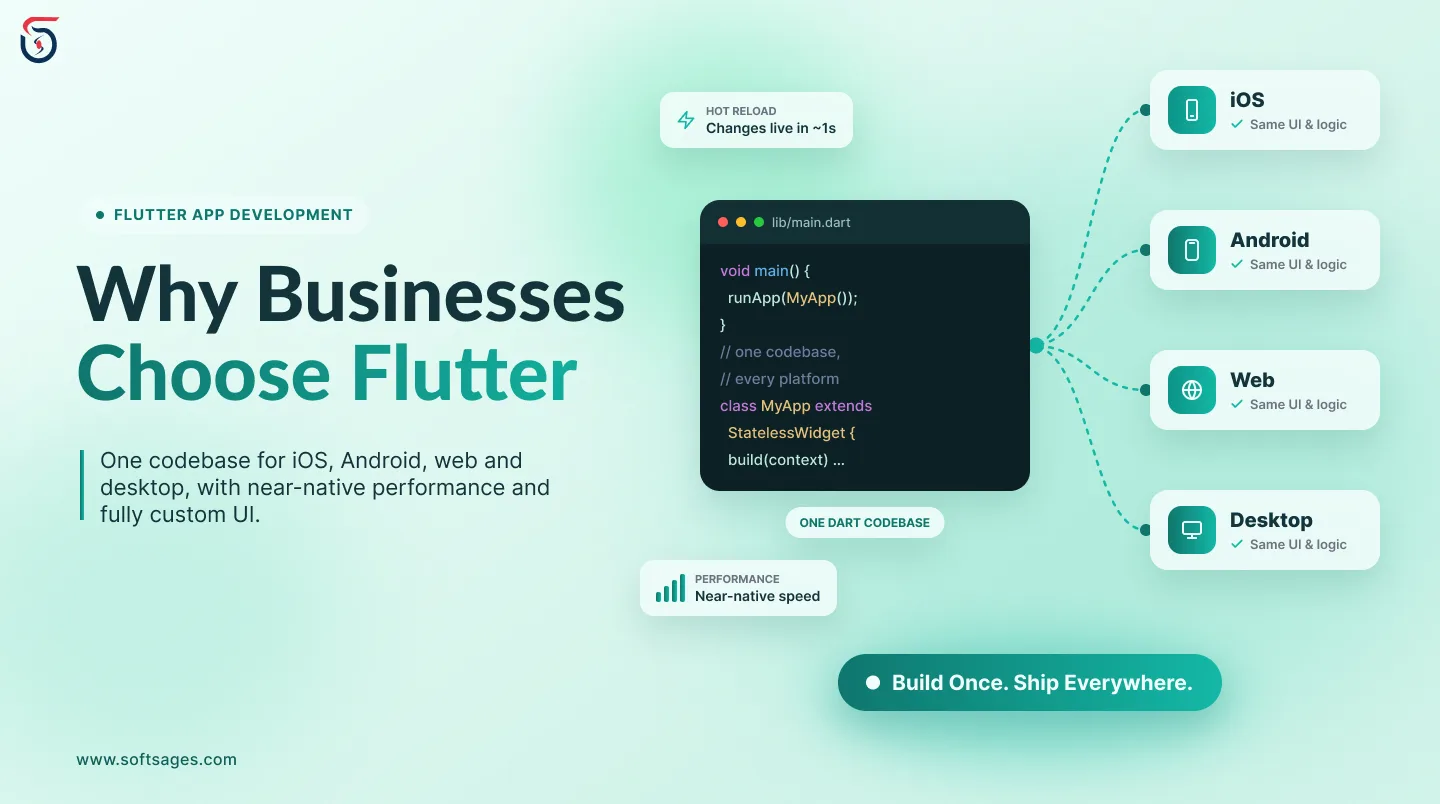
why businesses choose Flutter app development for iOS, Android, web, and desktop

1. What Is Flutter?


2. Why Businesses Are Choosing Flutter


3. Flutter vs React Native vs Native: Which Fits Your Use Case?


4. Flutter App Development Cost


5. Best Use Cases for Flutter


6. When Flutter May Not Be the Best Fit


7. How to Choose a Flutter App Development Company


8. Build Your Flutter App with SoftSages


9. Conclusion

Flutter app development has moved from "interesting option" to a default shortlist item for startups and enterprises alike. Google's open-source UI toolkit lets a team build iOS, Android, web, and desktop apps from a single codebase, without the usual compromise on design or speed.
If you are weighing a cross-platform app development approach, this guide explains why businesses are choosing Flutter, how it compares with React Native and native development, what it costs, and when it is not the right call.
Quick answer: Businesses choose Flutter because it cuts time-to-market and maintenance effort (one codebase), delivers near-native performance and fully custom UI, and is backed by Google with a fast-growing ecosystem.

What Is Flutter?

Flutter is Google's open-source framework for building natively compiled applications for mobile, web, and desktop from one codebase. It uses the Dart programming language and draws every pixel with its own rendering engine instead of relying on platform UI components. That is why a Flutter app looks and behaves the same on every device.
Large brands such as Google Pay, BMW, Alibaba, and eBay Motors have publicly used Flutter in production, which signals the framework is mature enough for serious business workloads.

Why Businesses Are Choosing Flutter

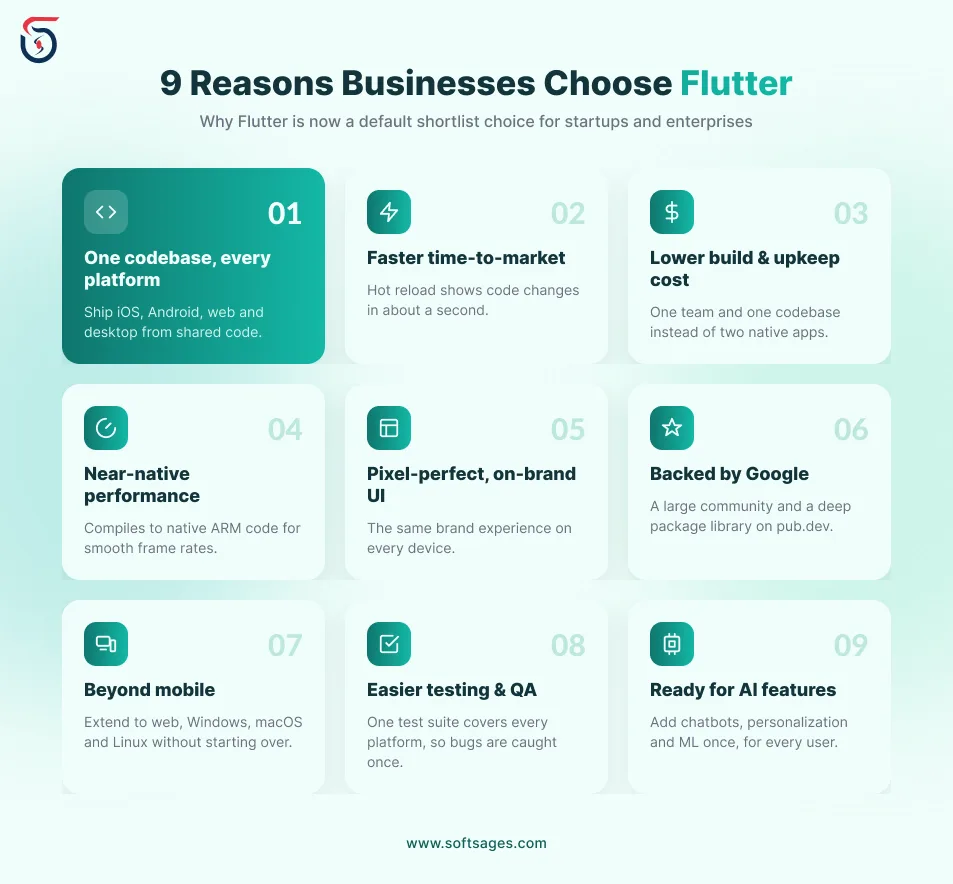
9 reasons businesses choose Flutter for app development

1. One codebase, every platform

Instead of maintaining separate iOS (Swift) and Android (Kotlin) teams, a Flutter team ships to both, plus web and desktop, from shared code. Fewer duplicated features means fewer duplicated bugs, and every release reaches all users at the same time.

2. Faster time-to-market

Flutter's hot reload shows code changes in the running app in about a second. Combined with a rich widget library, this shortens design-to-demo cycles, which is ideal for MVPs, pilots, and investor deadlines.

3. Lower development and maintenance cost

One team and one codebase generally means lower build and upkeep costs than two native apps. Vendor estimates often claim 30-60% savings versus native, but treat that as a range: the real number depends on scope, platform-specific features, and team skill.

4. Near-native performance

Flutter compiles to native ARM code and renders through its own engine (Impeller on modern builds), which delivers smooth, consistent frame rates for animation-heavy interfaces. For most business apps, such as commerce, fintech, healthcare, and on-demand, users cannot tell the difference from native.

5. Pixel-perfect, brand-consistent UI

Because Flutter controls rendering, your brand experience is identical on a budget Android phone and the latest iPhone. Designers get freedom to build custom animations and layouts rather than being limited by platform widgets.

6. Backed by Google and a growing ecosystem

Flutter has a large, active community and a deep package library on pub.dev. Industry reports commonly put it at or near the top of cross-platform framework usage, with one 2026 figure (Statista, as cited by Tech-Insider) at roughly 42% of developers versus about 38% for React Native. Sources vary, so treat adoption numbers as directional rather than exact.

7. Beyond mobile: web, desktop, and embedded

A single Flutter codebase can target Android, iOS, web, Windows, macOS, and Linux. That lets businesses extend a mobile product to other surfaces without starting over, and keep logic and design consistent.

8. Easier testing and quality control

One codebase means one set of unit, widget, and integration tests covering every platform. QA effort drops, and regressions are caught once, not twice.

9. Future-ready for AI-powered features

Flutter integrates with cloud AI services, on-device ML, and APIs for chatbots, personalization, and recommendations. Teams can add intelligent features to one shared app instead of building them per platform.

Flutter vs React Native vs Native: Which Fits Your Use Case?

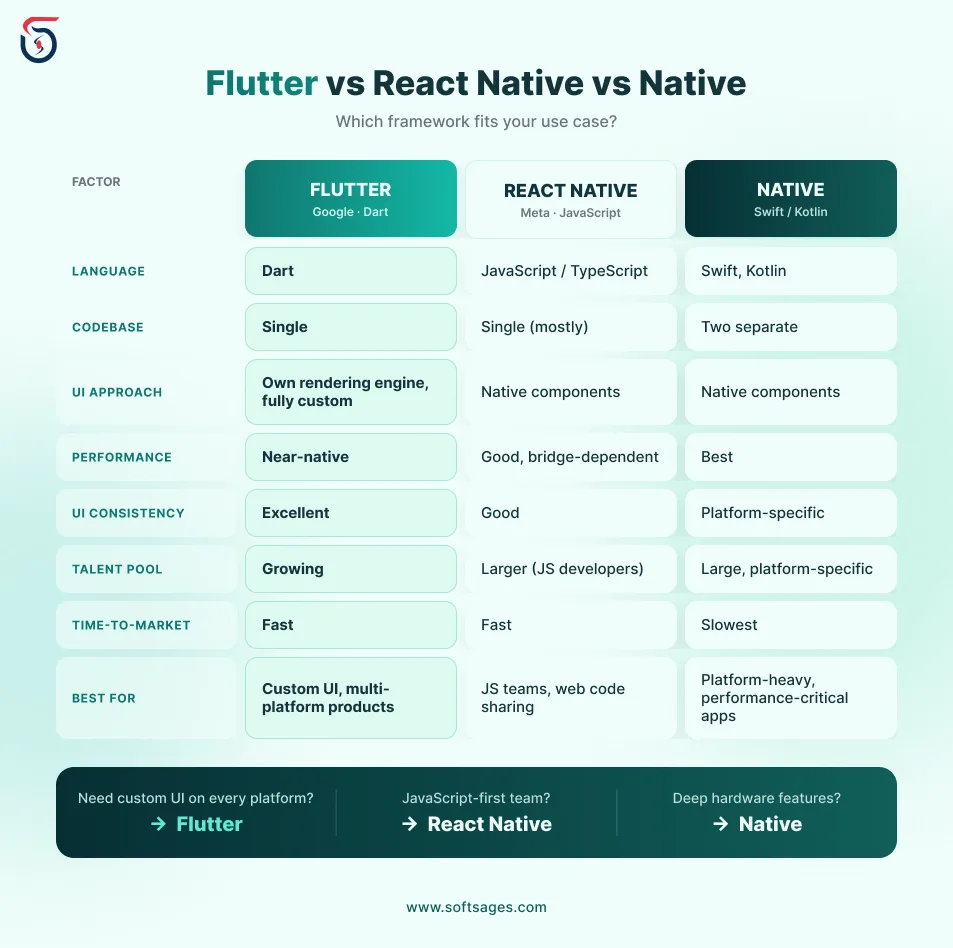
Flutter vs React Native vs native app development comparison
FactorFlutterReact NativeNative (Swift/Kotlin)
LanguageDartJavaScript / TypeScriptSwift, Kotlin
CodebaseSingleSingle (mostly)Two separate
UI approachOwn rendering engine, fully customNative componentsNative components
PerformanceNear-nativeGood, bridge-dependentBest
UI consistency across platformsExcellentGoodPlatform-specific
Talent poolGrowingLarger (JS developers)Large, platform-specific
Time-to-marketFastFastSlowest
Best forCustom UI, multi-platform productsJS teams, web code sharingPlatform-heavy, performance-critical apps
Takeaway: Choose Flutter when design consistency, animation, and multi-platform reach matter. Choose React Native if your team is JavaScript-first. Choose native when you need deep, platform-specific hardware features.

Flutter App Development Cost

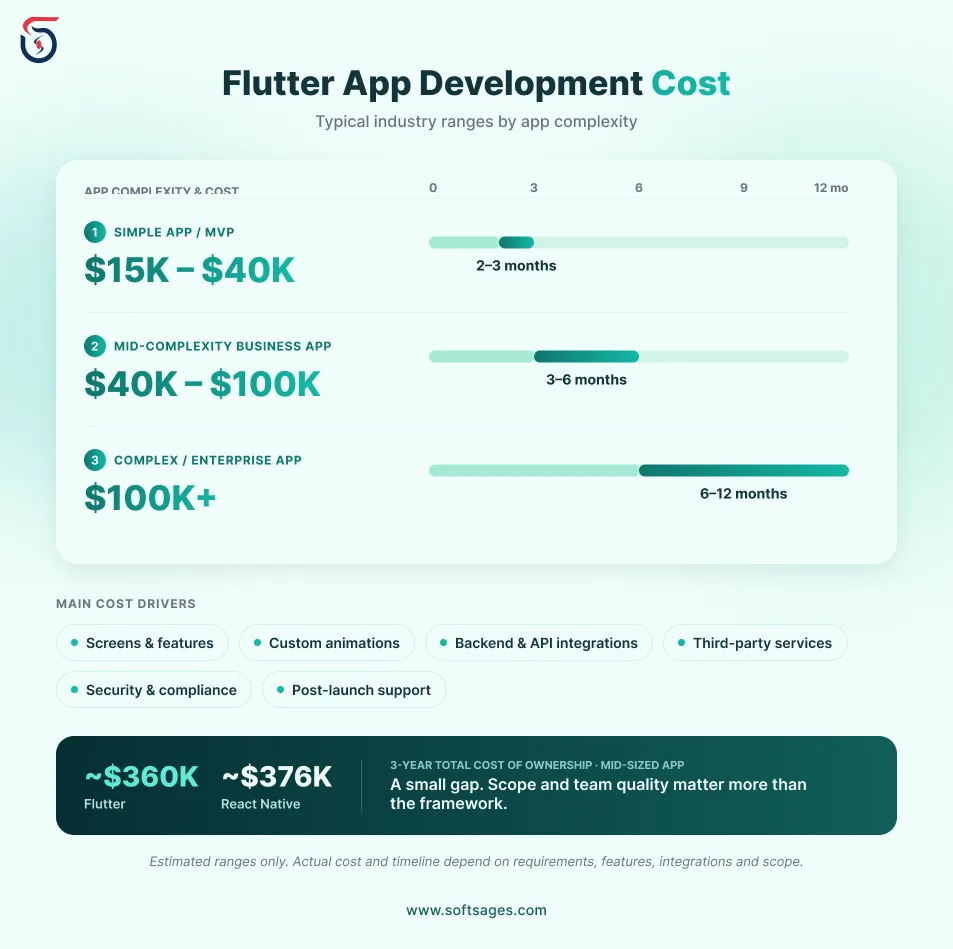
Flutter app development cost and timeline by app complexity
Typical ranges quoted across the industry:
App complexityTypical cost (USD)Typical timeline
Simple app / MVP$15,000 - $40,0002-3 months
Mid-complexity business app$40,000 - $100,0003-6 months
Complex / enterprise app$100,000+6-12 months
Note: These are estimated cost and timeline ranges. Actual costs and delivery timelines depend on the project's requirements, complexity, features, integrations, and scope of work. Final estimates may vary based on the specific project and its delivery requirements.
Indicative only; actual quotes vary by region, feature set, integrations, and team. One enterprise analysis put three-year total cost of ownership for mid-sized apps at roughly $360K for Flutter versus $376K for React Native, a small gap, which shows that scope and team quality matter more than the framework.
Main cost drivers: number of screens and features, custom animations, backend and API integrations, third-party services, security and compliance, and post-launch support.

Best Use Cases for Flutter

  • ◆Startups and MVPs: validate fast on both platforms with one budget.
  • ◆E-commerce and retail apps: consistent, branded shopping experiences.
  • ◆Fintech and banking: secure, polished UIs with strong animation.
  • ◆Healthcare and telemedicine: accessible interfaces across devices.
  • ◆On-demand and logistics apps: real-time tracking, maps, and notifications.
  • ◆Enterprise internal tools: one app for field teams on mixed devices.

When Flutter May Not Be the Best Fit

Being honest builds trust, so consider alternatives if:
  • ◆You need deep, cutting-edge access to platform-specific APIs (some AR/VR or hardware-heavy apps).
  • ◆Your team is entirely JavaScript and wants maximum code sharing with an existing web app.
  • ◆App size is extremely constrained, since Flutter apps ship their own engine and can be larger.
  • ◆You rely on niche third-party SDKs that have no Flutter plugin.

How to Choose a Flutter App Development Company

  • Portfolio: look for shipped Flutter apps on both stores, not just demos.
  • Architecture skills: clean architecture, state management (Bloc, Riverpod, Provider), and CI/CD.
  • Full-stack capability: backend, cloud, security, and UI/UX under one roof.
  • Post-launch support: updates, monitoring, and OS-version compatibility.
  • Transparent process: clear estimates, milestones, and communication.
  • Flexible engagement: fixed scope, dedicated team, or staff augmentation.

Build Your Flutter App with SoftSages

At SoftSages Technology, our mobile app development services help startups and enterprises plan, design, build, and support high-performing apps. With delivery teams across the US, Canada, the UK, and India, we offer end-to-end UI/UX, development, QA, and ongoing support, with no sales pressure.
Google Preferred Sources banner for SoftSages Technology

Never Miss an Update

Add SoftSages Technology as a Preferred Source on Google for more of our latest tech content in AI Mode and AI Overviews.

Add to Google Preferred Sources

Conclusion

Businesses are choosing Flutter app development because it combines speed, cost efficiency, strong performance, and a consistent, branded experience across platforms, all from one codebase. It is not the answer to every project, but for most business apps it is one of the strongest options available in 2026.

Ready to explore Flutter for your product? Book a free consultation with SoftSages Technology and get a clear scope, timeline, and estimate.

Table of contents

What Is Flutter?


Why Businesses Are Choosing Flutter

Flutter vs React Native vs Native: Which Fits Your Use Case?

Flutter App Development Cost


Best Use Cases for Flutter


When Flutter May Not Be the Best Fit


How to Choose a Flutter App Development Company


Build Your Flutter App with SoftSages


Conclusion

Join Our Newsletter

Get the latest tech trends, tutorials and expert analysis delivered straight to your inbox.

FAQs About Flutter App Development

Yes. Flutter suits business apps because it reduces cost and delivery time, offers consistent UI on all platforms, and scales from MVP to enterprise.

Neither is universally better. Flutter excels at custom UI and consistent multi-platform experiences; React Native is strong for JavaScript teams and web code sharing.

Simple apps typically start around $15,000-$40,000, mid-complexity apps $40,000-$100,000, and complex enterprise apps above $100,000, depending on features and integrations.

An MVP often takes 2-3 months; larger apps take 6-12 months.

Yes. One Dart codebase builds for iOS and Android, and also for web and desktop.

Yes, with the right architecture, testing, and security practices. Large organizations already run Flutter in production.

Yes. Flutter targets web, Windows, macOS, and Linux in addition to mobile.