


Legacy System Modernization Strategies: A Practical Guide
1. What Is Legacy System Modernization?
2. The 7 Rs: A Framework for Choosing Your Approach
3. When to Modernize vs. When to Just Connect
4. The Strangler Fig Pattern: Modernizing Without a Cutover Event
5. How AI Is Transforming Legacy System Modernization
6. Security and Compliance: Why Zero Trust Matters Here
7. A Practical Decision Framework for Your Portfolio
8. Modernizing Legacy Systems for Future Growth
What Is Legacy System Modernization?
The 7 Rs: A Framework for Choosing Your Approach
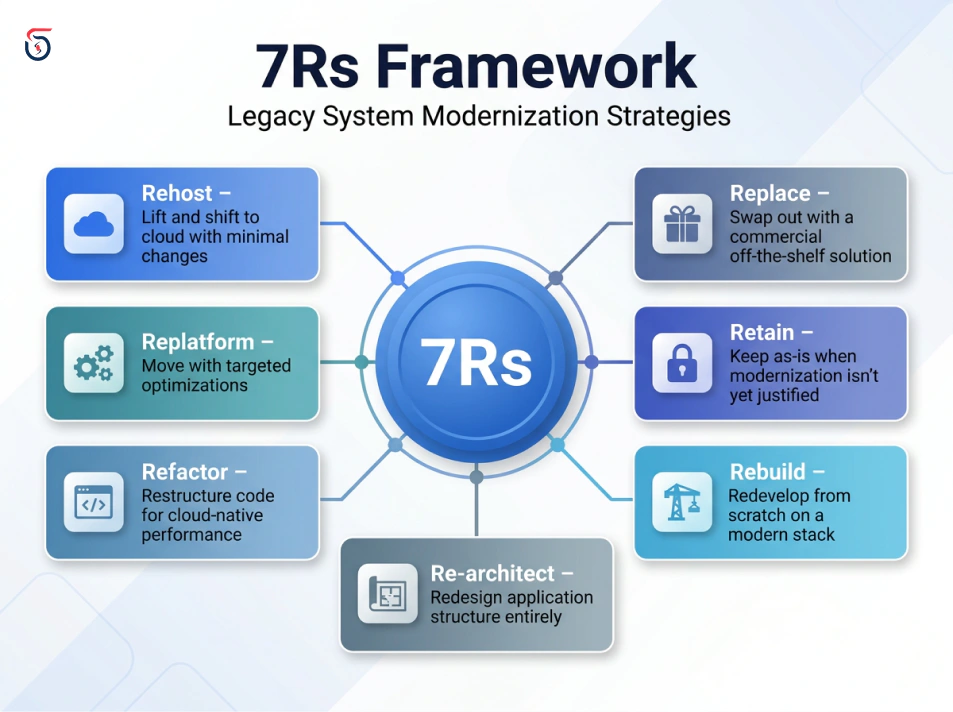
- ◆Retire: Decommission systems that no longer serve a real purpose. This should usually happen first, since it reduces the scope of everything else.
- ◆Retain: Leave a system as-is, at least for now, when it still works reliably and modernizing it isn't a near-term priority.
- ◆Rehost: Move infrastructure to modern hardware or cloud with no code changes ("lift and shift"). Fastest and lowest-risk option, though it doesn't fix structural problems underneath.
- ◆Replatform: Move and make targeted improvements without redesigning the core architecture, for example, swapping a self-managed database for a managed cloud service.
- ◆Refactor: Restructure the code itself without changing its external behavior, improving maintainability and reducing technical debt.
- ◆Rearchitect: Redesign the system's architecture more fundamentally. this often means moving toward a modular monolith rather than full microservices, which has become the more pragmatic default for many teams.
- ◆Rebuild: Start fresh while deliberately preserving the underlying business logic the legacy system has accumulated over time.
When to Modernize vs. When to Just Connect
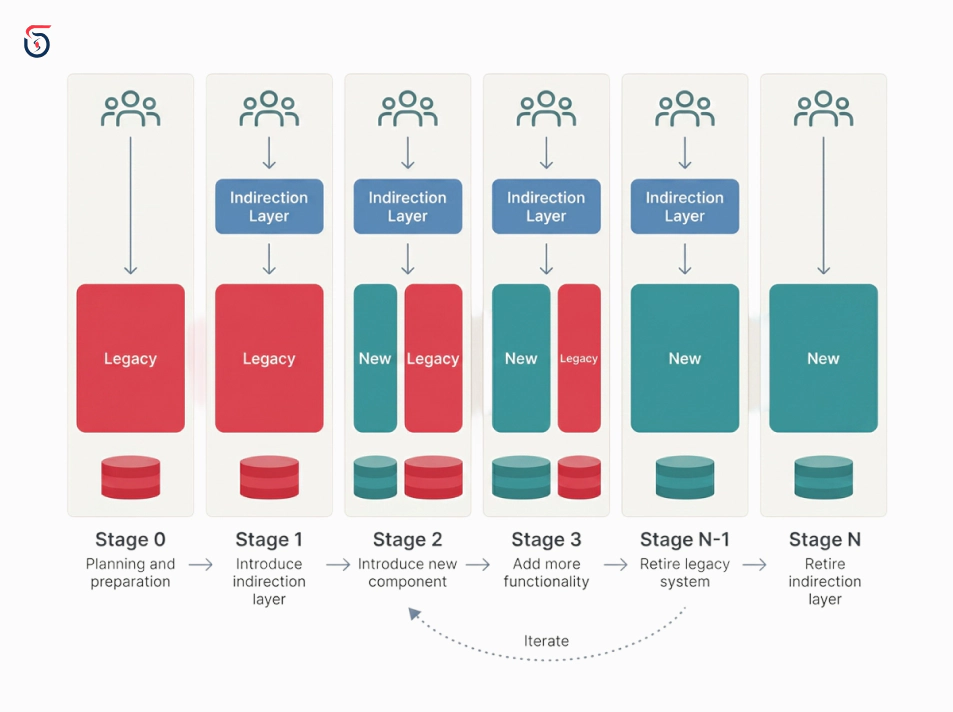
The Strangler Fig Pattern: Modernizing Without a Cutover Event
- ◆Placing a routing layer in front of the legacy system.
- ◆Building new functionality incrementally outside the legacy core.
- ◆Gradually redirecting traffic to the new components as they're ready.
- ◆Letting the legacy system retire piece by piece, with no single high-stakes cutover event.
How AI Is Transforming Legacy System Modernization
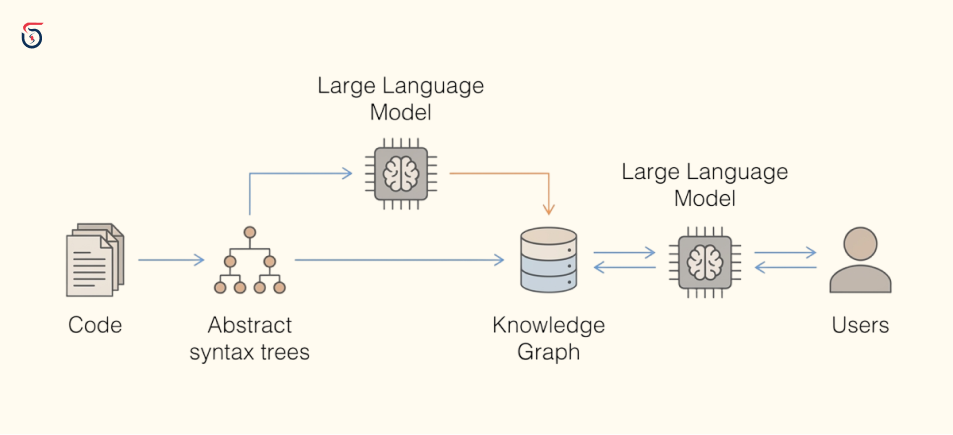
- ◆Code analysis and dependency mapping. AI tools can scan large, undocumented codebases to identify dependencies, dead code, and modernization candidates far faster than engineers manually reading through millions of lines, which used to be standard practice for legacy systems with little documentation.
- ◆Automated migration and refactoring assistance. AI-assisted refactoring can help translate outdated languages, break monolithic code into more manageable units, and generate scaffolding for testing, accelerating timelines that traditionally took years.
- ◆Continuous testing during migration. Rather than testing only at the end of a migration phase, AI-assisted testing can run continuously alongside the migration process, flagging anomalies before they reach production and meaningfully reducing post-migration defects.
- ◆Smarter prioritization. AI-driven assessment can score applications by technical state, business contribution, and operational risk, making the decision of which systems to rehost, replatform, refactor, or retire considerably more evidence-based than it used to be.
Security and Compliance: Why Zero Trust Matters Here
A Practical Decision Framework for Your Portfolio
- ◆Quantify the real cost of staying still. Use your own maintenance spend, incident history, and blocked-project list, not just industry benchmarks, to make the business case concrete rather than abstract.
- ◆Triage systems by business impact and technical risk, not by how old or unfamiliar they feel. A genuinely stable legacy system that's simply unfashionable doesn't need the same urgency as one quietly blocking three other initiatives.
- ◆Pick a first domain that's painful but not existential. Choose somewhere you can realistically show measurable progress within six to twelve months, and use it to prove out your approach before scaling further.
- ◆Match each system to the right one (or two) of the 7 Rs, rather than defaulting to the same approach across your entire portfolio.
- ◆Build in continuous validation, not a single go-live event. Whether through the Strangler Fig pattern or staged replacement, parallel validation against the legacy system reduces the risk of a painful surprise at cutover.
- ◆Treat modernization as a rolling program, not a one-off project. Each completed slice should reduce technical debt and build institutional confidence for the next one, turning modernization into a sustained capability rather than a single initiative that ends when the budget runs out.

Never Miss an Update
Add SoftSages Technology as a Preferred Source on Google for more of our latest tech content in AI Mode and AI Overviews.
Modernizing Legacy Systems for Future Growth
Still running critical operations on systems that are quietly costing you more every year? SoftSages helps businesses modernize legacy systems strategically, using the right mix of rehosting, refactoring, and rearchitecting for each system in your portfolio, without putting daily operations at risk. 👉 Talk to a Software Development Expert and get a clear, no-pressure assessment of where your legacy systems actually stand.
Table of contents
What Is Legacy System Modernization?
The 7 Rs: A Framework for Choosing Your Approach
When to Modernize vs. When to Just Connect
The Strangler Fig Pattern: Modernizing Without a Cutover Event
How AI Is Transforming Legacy System Modernization
Security and Compliance: Why Zero Trust Matters Here
A Practical Decision Framework for Your Portfolio
Modernizing Legacy Systems for Future Growth
Join Our Newsletter
Get the latest tech trends, tutorials and expert analysis delivered straight to your inbox.
FAQs about Legacy System Modernization Strategies
The most effective strategies follow the 7 Rs framework, retire, retain, rehost, replatform, refactor, rearchitect, or rebuild, applied selectively across a portfolio rather than using one single approach for every system.
It's a modernization approach where a routing layer sits in front of a legacy system, new functionality is built incrementally outside it, and traffic is gradually redirected, allowing the legacy system to retire piece by piece without one risky cutover event.
Integration often makes more sense when the legacy system still performs its core function reliably and replacing it would cost more than connecting it. A rebuild becomes the better option when the system actively blocks AI integration, real-time data needs, or other strategic capabilities.
AI accelerates modernization through automated code analysis, dependency mapping, AI-assisted refactoring, and continuous testing during migration, but it works best paired with human oversight and a clear target architecture, not as a fully automated replacement for expert judgment.
The biggest risk is attempting a single, large "big-bang" transformation instead of an incremental approach. Big-bang rewrites have a notoriously poor track record compared to phased, measurable modernization programs.
Timelines vary significantly by system complexity and approach, but organizations using AI-assisted modernization and phased strategies often see meaningfully faster timelines than traditional, fully manual migration projects.
A modular monolith is an architecture that organizes code into clear, independent modules within a single deployable application, rather than splitting everything into microservices. Many teams now treat it as a more pragmatic rearchitecture target than full microservices.
Legacy systems were often built assuming threats only come from outside a network perimeter, an assumption that no longer holds. Zero Trust embeds identity verification and access control by design, which matters especially as legacy systems get connected to broader modern ecosystems.
Prioritize based on business impact and technical risk rather than how old a system feels. Choose a domain that's painful but not existential, where you can demonstrate measurable progress within six to twelve months.
No. Mid-market companies increasingly have access to the same AI-assisted modernization tools and structured frameworks that were once only practical for enterprise budgets, making professional-grade modernization more accessible than in previous years.